Industrial buyers searching for diamond and CBN tool manufacturers in the world are not comparing one interchangeable product category. The market includes precision grinding-wheel specialists, diamond dresser manufacturers, PCD and PCBN cutting-tool suppliers, and upstream superhard-material companies. A supplier that is strong in vitrified CBN wheels for bearing production may not be the right source for PCD inserts, semiconductor dicing tools or electroplated profile wheels.
This 2026 guide compares ten established manufacturers outside mainland China. The shortlist deliberately avoids repeating the companies featured in our broader global abrasive manufacturers guide. It focuses on technical fit, supplier role and buying questions for superabrasive tools rather than general coated or bonded abrasives.
The order is not a revenue or market-share ranking. Product availability, manufacturing locations and local sales arrangements can change by region. Buyers should confirm the exact tool, plant, specification and contracting entity before placing an order.
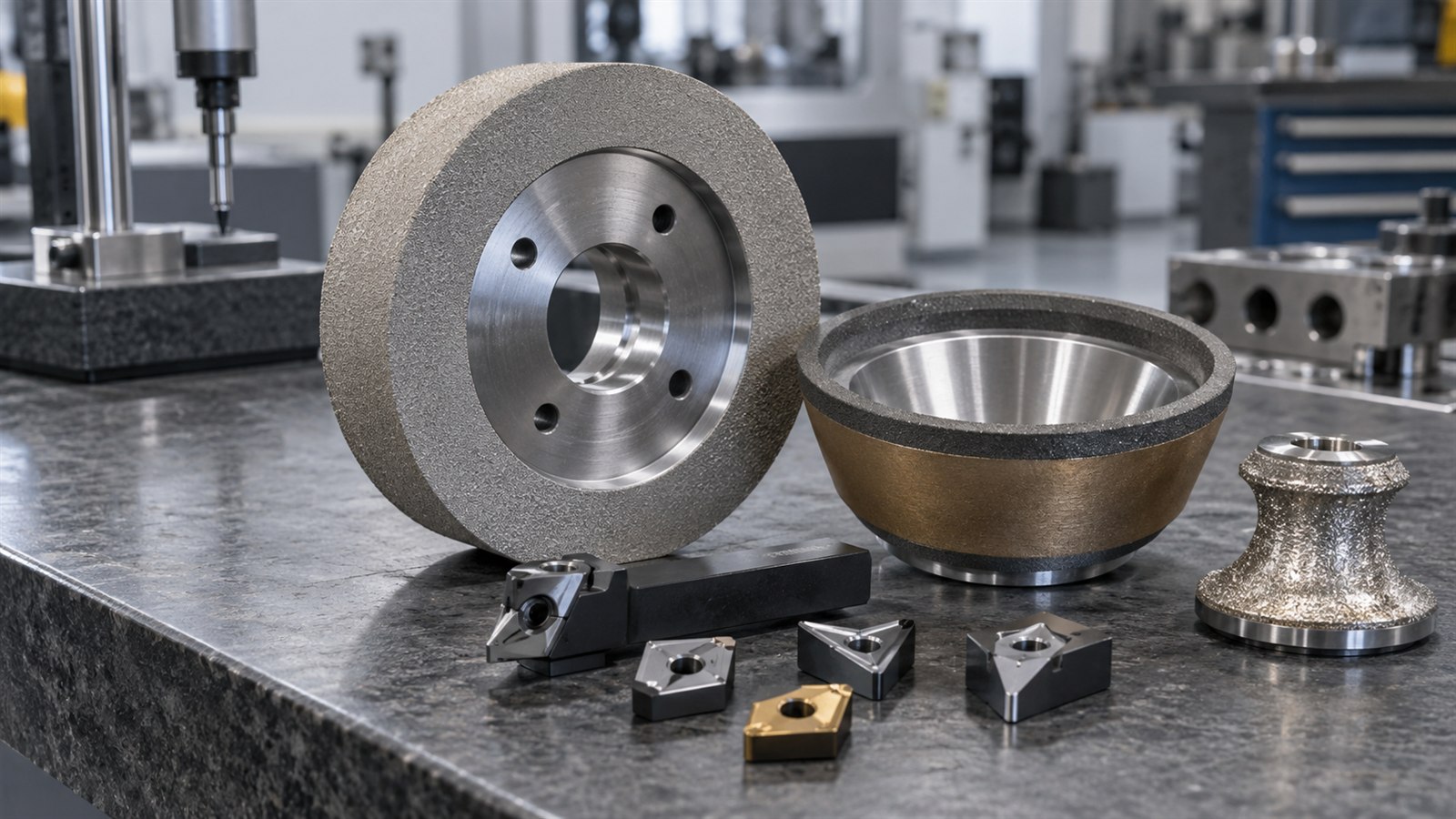
How We Selected These Diamond and CBN Tool Manufacturers
We evaluated these diamond and CBN tool manufacturers through their official websites, published superabrasive ranges and recognizable industrial sourcing roles. The list balances three supplier models: manufacturers of diamond and CBN grinding tools, manufacturers of PCD/PCBN cutting tools, and companies that provide related technologies such as dressers, honing products or application engineering.
- Product relevance: diamond, CBN, PCD or PCBN must be a stated part of the industrial portfolio.
- Technical depth: the company publishes meaningful information about applications, bonds, materials or tool selection.
- Commercial usefulness: the supplier serves industrial buyers rather than only consumer or construction retail.
- Supplier diversity: the shortlist covers both grinding and defined-edge cutting instead of treating every superabrasive product as the same tool.
- Global availability: each company has international sales, distribution or application-support capability described on its official site.
Quick Comparison of 10 Global Diamond and CBN Tool Manufacturers
| No. | Manufacturer | Base | Primary superabrasive role | Useful starting point |
|---|---|---|---|---|
| 1 | Asahi Diamond Industrial | Japan | Diamond/CBN wheels, dressers, cutting and semiconductor tools | Broad custom superabrasive programs |
| 2 | Tokyo Diamond Tools | Japan | Custom diamond/CBN grinding and precision cutting tools | Complex profiles, hard-brittle materials and precision machining |
| 3 | EHWA Diamond Industrial | South Korea | Grinding wheels, honing tools, dressers and PCD/PCBN tools | Automotive, bearing, glass and cutting-tool applications |
| 4 | Meister Abrasives | Switzerland | High-precision vitrified and hybrid CBN/diamond grinding tools | ID/OD, double-disc and superfinishing processes |
| 5 | Continental Diamond Tool | United States | Custom plated and bonded diamond/CBN wheels and tools | Made-to-print wheels and reconditioning programs |
| 6 | Sumitomo Electric Hardmetal | Japan | PCD and PCBN inserts, grades and complete cutting tools | Hard turning, cast iron and aluminum machining |
| 7 | Kennametal | United States | PCBN and PCD indexable cutting-tool systems | Hardened-steel and abrasive non-ferrous machining |
| 8 | Noritake | Japan | CBN/diamond wheels for automotive and precision grinding | Crankshaft, centerless and high-efficiency production grinding |
| 9 | Krebs & Riedel | Germany | CBN/diamond grinding wheels and dressing tools | Gear, cylindrical and high-speed precision grinding |
| 10 | Molemab | Italy | Vitrified, resin, metal, hybrid and electroplated superabrasives | Mixed industrial grinding programs and tailored bonds |
1. Asahi Diamond Industrial

Official website: Asahi Diamond Industrial
Asahi Diamond Industrial presents one of the broadest specialist portfolios in this shortlist. Its published business areas cover diamond and CBN wheels, precision cutting tools, semiconductor-processing tools, diamond dressers, roller dressers, wire-drawing dies and PCD/PCBN materials. The company also states that many products are manufactured to order, which matters when wheel geometry, abrasive layer design and process conditions cannot be standardized.
Asahi is a useful reference for buyers with several connected superabrasive requirements, such as grinding, dressing and precision cutting within one manufacturing group. The buyer should still identify the responsible division and product family. A semiconductor wheel, an automotive CBN wheel and a diamond rotary dresser follow different qualification paths.
Verify before buying: exact bond system, wheel or tool drawing, abrasive-layer dimensions, operating speed, truing and dressing method, and whether the quoted product is standard or application-engineered.
2. Tokyo Diamond Tools

Official website: Tokyo Diamond Tools Mfg.
Tokyo Diamond Tools manufactures diamond and CBN grinding wheels, electroplated tools, cutting tools, dressers and related precision products. Its technical pages separate diamond from CBN by workpiece chemistry and describe resin, metal, vitrified and electroplated bond options. Published applications extend from carbide and ceramics to hardened steel, precision molds, semiconductor components and PCD/PCBN tool grinding.
This company is especially relevant when the request involves a complex wheel profile, a small precision tool or a hard-and-brittle material that needs application-specific bond selection. It also publishes examples for CBN wheel use on bearings, molds, HSS tools and industrial blades, which gives buyers a practical basis for discussing the process.
Verify before buying: drawing tolerances, allowable runout, coolant, form-holding target, material-removal rate and whether the tool can be replated, retrued or reconditioned.
3. EHWA Diamond Industrial

Official website: EHWA Diamond Industrial
EHWA’s precision-machining portfolio includes grinding wheels, honing products, diamond dressers and PCD, PCBN and CVD diamond cutting tools. Its application material covers automotive powertrain components, bearings, glass, cutting tools, turbine parts and medical components. This breadth makes EHWA more than a single wheel supplier, but buyers should use the relevant product catalog rather than assume that one sales route covers every division.
EHWA is a logical candidate for production lines that connect grinding, honing and dressing, particularly where process support and repeatability matter. The company also publishes separate precision-machining catalogs, allowing an RFQ to be tied to a defined application instead of a generic request for a “diamond wheel.”
Verify before buying: local technical support, trial procedure, bond and concentration, dressing interval, target cycle time and the dimensional data used for repeat orders.
4. Meister Abrasives

Official website: Meister Abrasives
Meister Abrasives is positioned around high-precision, customer-specific superabrasive grinding solutions. Its official product information highlights diamond and CBN tools for internal and external grinding, double-disc fine grinding, superfinishing and semiconductor-related processes. Ceramic and hybrid bonds are central to several of its published technologies.
Meister is most relevant when surface quality, component geometry, porosity, bond behavior and process stability are more important than buying a standard wheel from stock. That makes the company a strong comparison point for bearings, automotive components, medical parts, e-mobility and high-precision coated surfaces.
Verify before buying: machine stiffness, wheel speed, coolant delivery, dressing system, stock allowance, permissible thermal damage and the measurement method for surface finish and geometry.
5. Continental Diamond Tool

Official website: Continental Diamond Tool
Continental Diamond Tool describes itself as a manufacturer of plated and bonded diamond and CBN wheels and tools, including custom sizes, profiles and specifications. Its catalog structure is useful for buyers that already have a drawing or an existing wheel to replace and need a made-to-print superabrasive solution rather than a broad general-abrasive program.
The company is worth considering for electroplated profile tools, bonded grinding wheels and applications where stripping, replating or reconditioning can reduce total tooling cost. The commercial comparison should therefore include service life and core reuse, not only the initial wheel price.
Verify before buying: ownership of the core and drawing, replate eligibility, inspection report, abrasive exposure, profile tolerance, lead time for first articles and turnaround time for reconditioning.
6. Sumitomo Electric Hardmetal

Official website: Sumitomo Electric Hardmetal CBN/PCD tools
Sumitomo Electric Hardmetal represents the defined-edge cutting-tool side of the market. Its SUMIBORON and SUMIDIA ranges cover PCBN and PCD grades, inserts, chipbreakers, small-diameter boring tools, milling cutters and selected binderless diamond or CBN products. Published application groups include hardened steel, cast iron, sintered alloys, aluminum and hard-brittle materials.
This makes Sumitomo a relevant benchmark for high-volume hard turning and non-ferrous machining rather than for bonded grinding wheels. Buyers should compare the complete insert grade and edge preparation, not simply ask for “CBN.” CBN content, binder, coating, chamfer, hone and chipbreaker can change performance under continuous and interrupted cuts.
Verify before buying: workpiece grade and hardness, interruption severity, stock allowance, speed and feed window, coolant strategy, insert geometry and cost per acceptable component.
7. Kennametal

Official website: Kennametal
Kennametal offers PcBN and PCD-tipped inserts within broader turning, grooving and profiling systems. Its published PcBN ranges address hardened steels and several levels of interrupted cutting, while PCD grades are offered for abrasive non-ferrous and non-metallic workpieces. The value for buyers is the integration of insert material, holder geometry and application data within a standardized tooling system.
Kennametal is a practical candidate when a factory needs globally supported indexable tooling and documented grade selection rather than a custom grinding wheel. It also provides a useful reference for evaluating whether a special PCD/PCBN tool is necessary or whether a standard insert and holder can meet the operation.
Verify before buying: grade availability by region, insert seat and holder compatibility, minimum order quantity for special tools, edge-preparation tolerance and whether the recommendation assumes continuous or interrupted machining.
8. Noritake

Official website: Noritake grinding and polishing tools
Noritake publishes diamond and CBN wheel solutions for demanding production grinding, including crankshaft grinding, centerless processing, internal grinding and cutting-tool manufacturing. Examples on its official site include vitrified CBN/diamond centerless wheels, brazed single-layer CBN products and application-specific CBN wheels designed to control grinding resistance and thermal damage.
Noritake is most relevant to plants that need a wheel integrated with machine, coolant, dressing and inspection conditions. Buyers comparing it with other manufacturers should use a defined operation and measurable targets rather than comparing product names or grit size in isolation.
Verify before buying: wheel peripheral speed, core design, balance grade, coolant and filtration, dressing parameters, acceptable burn criteria and the production volume used to calculate tool life.
9. Krebs & Riedel

Official website: Krebs & Riedel CBN and diamond tools
Krebs & Riedel manufactures high-precision grinding wheels and publishes a dedicated diamond and CBN range. The company lists vitrified, resin, metal, hybrid and electroplated bond options together with diamond form rolls, profile rolls and stationary dressing tools. Its application strengths include cylindrical, gear, tool and other high-speed grinding processes.
A distinctive area is lightweight or vibration-damping wheel-body technology for demanding grinding conditions. This matters where large wheel mass, interrupted contact or surface-quality requirements place additional load on the spindle and process. Such benefits need to be validated on the actual machine rather than assumed from wheel construction alone.
Verify before buying: maximum operating speed, wheel-body material, balancing and mounting requirements, dressing strategy, profile retention and on-site application-support availability.
10. Molemab

Official website: Molemab abrasive wheels and tools
Molemab’s product range covers conventional grinding wheels as well as vitrified, resin, metal, hybrid and electroplated diamond/CBN tools and diamond dressers. Its published industries include automotive, aerospace, bearings, oil and gas, medical, railway, renewable energy and semiconductor wafer processing.
Molemab is a useful option for buyers that need both conventional and superabrasive wheels across several processes, or that require a bond tailored to a specific application. The qualification process should separate catalog products from engineered specifications and identify which factory or division will manufacture the quoted tool.
Verify before buying: manufacturing location, bond family, test standard, shelf-life or storage requirements where relevant, wheel marking, safety documentation and repeat-order control.
Which Diamond and CBN Tool Manufacturers Fit Your Process?
| Buying requirement | Supplier type to prioritize | Companies in this guide to investigate |
|---|---|---|
| Vitrified CBN wheels for bearings, automotive or precision OD/ID grinding | Application-engineered grinding-wheel manufacturer | Meister, Noritake, Asahi, Krebs & Riedel, EHWA |
| Diamond wheels for carbide, ceramics, optics or semiconductor materials | Diamond-tool specialist with bond and profile capability | Asahi, Tokyo Diamond Tools, Meister, EHWA |
| Custom electroplated profile wheel or reusable metal core | Electroplated custom-tool manufacturer with replate service | Continental Diamond Tool, Tokyo Diamond Tools, EHWA |
| PCBN inserts for hardened steel or cast iron | Defined-edge cutting-tool supplier with grade and geometry support | Sumitomo Electric Hardmetal, Kennametal |
| PCD inserts or tools for aluminum and abrasive non-ferrous materials | PCD cutting-tool manufacturer with edge-preparation expertise | Sumitomo Electric Hardmetal, Kennametal, Tokyo Diamond Tools |
| Grinding, honing and dressing within one production line | Multi-process superabrasive group | EHWA, Asahi, Molemab |
If you are still deciding between the two abrasive systems, read our guide to CBN grinding wheels for hardened steel and superalloys. For defined cutting edges rather than grinding wheels, use the separate PCD vs CBN cutting tools selection guide.
What to Put in a Diamond or CBN Tool RFQ
When comparing diamond and CBN tool manufacturers, a useful RFQ describes the process rather than asking for a tool by name alone. For grinding wheels, provide the workpiece material and hardness, machine and spindle data, wheel shape and dimensions, bond preference if known, grit and concentration, wet or dry operation, coolant type, removal rate, cycle time, surface-finish target and dressing system. Include the current wheel specification and a drawing, but explain what must improve; copying an old code without process context can reproduce the same limitation.
For PCD or PCBN cutting tools, specify the exact alloy or material grade, hardness and heat treatment, operation, toolholder and insert seat, continuous or interrupted cut, stock allowance, speed, feed, depth of cut, coolant strategy, tolerance, finish and current failure mode. State whether the objective is longer life, higher speed, fewer offsets, improved finish or lower cost per accepted part.
- Part drawing and critical tolerances
- Machine model, spindle condition and available power
- Workpiece material certificate or precise grade
- Current tool specification and measured performance
- Target cycle time, tool life and surface requirement
- Annual volume, trial quantity and repeat-order forecast
- Inspection, traceability and documentation requirements
- Preferred delivery region and required local technical support
How to Compare Samples Without Choosing the Cheapest Tool
Run candidate tools under controlled conditions. Use the same machine, material lot, coolant, setup and measurement method. Record initial cut quality, power or spindle load, wheel wear or insert flank wear, dimensional drift, surface finish, thermal damage, dressing time, tool-change time and rejected parts. A tool that lasts longer can still be uneconomical if it increases cycle time or requires frequent correction.
For wheels, inspect balance, runout, profile accuracy and abrasive-layer consistency before production testing. For electroplated tools, confirm abrasive exposure and core condition. For PCD/PCBN inserts, document edge preparation and inspect wear under magnification at consistent intervals. Compare total cost per accepted component rather than purchase price per wheel or insert.
After the trial, freeze the specification that actually produced the result. A repeat order should reference the approved drawing, bond or grade, edge preparation, inspection criteria and revision level. This is particularly important when buying custom superabrasive tools because two visually similar products can behave differently in the cut.
Frequently Asked Questions
How should buyers compare diamond and CBN tool manufacturers?
There is no universal best supplier. Compare diamond and CBN tool manufacturers by the exact product family, workpiece material, machine conditions, application support and repeat-order controls. A strong grinding-wheel producer may not be the right source for a PCD insert or semiconductor dicing tool.
Should diamond or CBN be selected first?
Start with the workpiece and operation. Diamond is normally favored for carbide, ceramics, glass, semiconductor materials and many abrasive non-ferrous materials. CBN is normally favored for hardened ferrous materials and selected heat-resistant alloys. Bond, grit, concentration and tool geometry are selected after the abrasive family.
Are PCD and PCBN inserts the same as diamond and CBN grinding wheels?
No. PCD and PCBN inserts remove a chip with a defined cutting edge. Grinding wheels remove material with many abrasive grains held in a bond. They may use related superhard materials, but their specifications, machines, failure modes and qualification methods are different.
When is a custom tool justified?
Customization is justified when a standard tool cannot meet profile, access, tolerance, cycle-time or surface-integrity requirements, or when a reusable core and optimized abrasive layer lower total cost. A controlled trial should demonstrate the value before a large order.
What is the most important supplier-qualification question?
Ask which part of the product and process the supplier controls. Then request the technical data, drawing revision, inspection method and repeat-order controls for the exact tool being quoted. Brand recognition does not replace specification control.
How to Shortlist Diamond and CBN Tool Manufacturers
The best way to compare diamond and CBN tool manufacturers in the world is to group them by the job they perform. Asahi, Tokyo Diamond Tools and EHWA cover several connected superabrasive technologies. Meister, Noritake, Krebs & Riedel, Continental Diamond Tool and Molemab are useful references for precision grinding and dressing requirements. Sumitomo Electric Hardmetal and Kennametal are stronger starting points when the requirement is a PCD or PCBN cutting insert rather than a bonded wheel.
Build the shortlist from the material, machine, operation and target result. Send the same process data to each candidate, test samples under controlled conditions and approve a complete specification. That approach produces a more reliable sourcing decision than selecting a supplier from company size, country or a top-ten label alone.
Need Help Sourcing the Right Diamond or CBN Tool?
If you are looking for a custom diamond or CBN grinding wheel, PCD/PCBN cutting tool or a mixed abrasive order, send us your drawing, workpiece material, machine details and target result. Wewin can support specification matching, custom/OEM production, sample validation and export communication.