Hexagonal diamond, also known as lonsdaleite, has moved from a disputed meteorite curiosity toward a measurable bulk material. Recent high-pressure research has produced recoverable samples large enough for structural and mechanical testing, giving materials scientists a clearer view of how this carbon phase differs from conventional cubic diamond and where it may eventually be useful.

What Is Hexagonal Diamond?
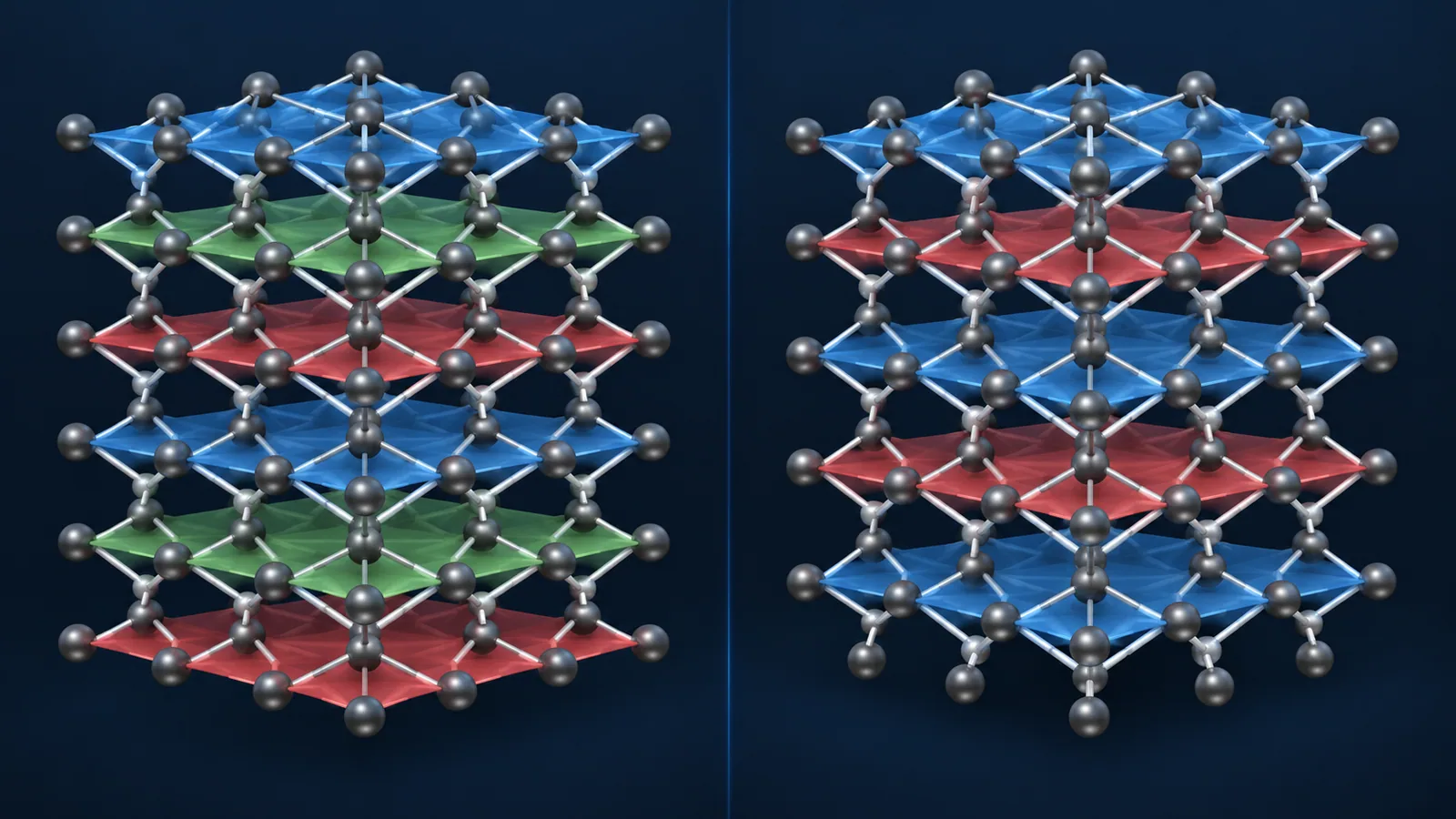
Both cubic diamond and hexagonal diamond are built from carbon atoms connected through strong three-dimensional sp3 bonds. The essential difference is the stacking sequence of their atomic layers.
- Cubic diamond follows an ABCABC stacking sequence.
- Hexagonal diamond follows an ABAB stacking sequence.
This apparently small structural change alters bond geometry, deformation pathways and shear response. For decades, calculations suggested that an ideal hexagonal structure could match or exceed the mechanical performance of cubic diamond. Proving that experimentally was difficult because reported natural material was normally nanoscale, mixed with cubic diamond or heavily affected by stacking faults.
From Meteorite Evidence to Bulk Synthetic Samples
The material was first reported in 1967 in fragments associated with the Canyon Diablo meteorite. It later became known as lonsdaleite, after crystallographer Kathleen Lonsdale. Meteorite impacts can generate enormous pressure and temperature for a very short time, making them plausible environments for unusual carbon transformations.
However, natural specimens did not settle the question. Their small size and structural disorder made it hard to determine whether lonsdaleite was a distinct carbon phase or faulted cubic diamond. A 2014 microscopy study argued that many earlier observations could be explained by twins and stacking faults in cubic diamond. Later high-pressure experiments produced material with strong hexagonal stacking, but bulk-property measurement remained limited.
Two recent studies marked a major change:
- A 2025 Nature study on the synthesis of bulk hexagonal diamond reported highly ordered samples ranging from about 100 micrometres to millimetre scale. The material was produced by compressing and heating high-quality graphite single crystals under controlled quasi-hydrostatic conditions.
- A separate 2026 Nature study on bulk hexagonal diamond reported millimetre-sized, phase-pure material made from highly oriented pyrolytic graphite compressed along its c-axis at elevated temperature. Structural characterization and simulation were used to identify the phase and clarify the graphite-to-diamond transformation pathway.
Together, these results provide substantially stronger evidence that recoverable bulk hexagonal diamond can exist as a discrete material rather than only as a nanoscale defect sequence inside ordinary diamond.
How Graphite Becomes Hexagonal Diamond
Graphite is made of carbon sheets held together much more weakly than the three-dimensional network in diamond. Under extreme pressure and heat, those sheets can shift, buckle and form new interlayer bonds. The final diamond structure depends on how the layers move and lock together during the transformation.
Recent experiments indicate that oriented graphite and carefully controlled stress are important. Compression can create interlayer bonds before heating, restricting how the carbon sheets slide. Under suitable pressure and temperature, this favours AB-type stacking and suppresses competing cubic-diamond formation. The 2026 work also combined advanced structural analysis with theoretical simulation to examine the layer-slip and bond-forming processes that convert graphite into phase-pure hexagonal diamond.
This mechanism matters industrially because repeatable synthesis is more valuable than a one-time laboratory result. Researchers must control precursor purity, crystallographic orientation, pressure distribution, heating profile and cooling conditions if they want consistent material properties.
Is Hexagonal Diamond Harder Than Cubic Diamond?
The short answer is promising, but it requires careful qualification. Hardness values depend on crystal orientation, test method, load, grain size, defects and sample quality. They should not be compared as if every test were performed under identical conditions.
The 2025 bulk-material study reported Vickers hardness values up to approximately 155 GPa under its stated test conditions. That is roughly 40% higher than a comparison value near 110 GPa for cubic diamond along a specified orientation. The 2026 phase-pure study described its bulk hexagonal diamond as slightly harder than cubic diamond and also reported a higher shear modulus.
The key point is not that every piece of hexagonal diamond is automatically “50% harder.” The more defensible conclusion is that carefully synthesized bulk hexagonal diamond has demonstrated mechanical performance that can exceed conventional cubic diamond in controlled measurements. Independent testing, larger samples and standardized methods are still needed before universal engineering values can be established.
Thermal Stability and Other Important Properties
Hardness is only one part of tool performance. Superhard materials must also resist fracture, chemical attack and thermal degradation. The 2025 work reported thermal stability up to about 1,100°C for its bulk hexagonal-diamond material, compared with about 900°C cited for ordinary nanopolycrystalline diamond in the same research context.
Diamond is also valued for very high thermal conductivity, wide bandgap, chemical inertness and optical transparency. Hexagonal stacking may change these properties in useful ways, but many application-specific values still need to be measured directly on reproducible bulk samples.
Potential Applications of Hexagonal Diamond
Extreme cutting and wear tools. A harder carbon phase with strong shear resistance could support future cutting, drilling and wear components for ceramics, non-ferrous alloys and other difficult materials. In practical tooling, however, performance will also depend on toughness, edge preparation, joining technology and tool geometry. Buyers comparing today’s commercial options can review our guide to PCD vs CBN cutting tools and our current range of PCD cutting tools.
Thermal management. Diamond-based materials already attract interest for heat spreaders in high-power electronics, lasers and communication systems. If bulk hexagonal diamond can be produced with reliable thermal properties and scalable dimensions, it may expand the design space for advanced heat-dissipation components.
Optical windows for extreme environments. High hardness, optical transparency and thermal stability could be useful in protective windows and sensor interfaces exposed to high pressure, heat or radiation. These applications require detailed optical, fracture and environmental testing rather than hardness data alone.
Quantum and sensing technologies. Controlled defects such as nitrogen-vacancy centres make diamond valuable for magnetic-field sensing, quantum information and precision measurement. Researchers will need to determine whether defects can be introduced and controlled in hexagonal diamond without destabilizing its structure.
What This Means for Diamond Tools Today
Hexagonal diamond is an important materials breakthrough, but it is not yet a drop-in replacement for commercial PCD, single-crystal diamond or diamond abrasive products. Current industrial tools benefit from mature synthesis routes, established quality control and proven joining systems. The new phase still faces questions about scalable manufacturing, cost, shape control, toughness, consistency and tool fabrication.
For present machining and grinding projects, material selection should still begin with the workpiece, operation and required surface finish. Our overview of grinding wheel abrasive materials explains where diamond, CBN, silicon carbide and aluminum oxide fit in current production. For custom superabrasive tooling, specifications such as workpiece composition, hardness, machine speed, coolant, tolerance and target finish remain essential.
Conclusion
Recent bulk-synthesis results have transformed hexagonal diamond from a long-debated structure into a material that can be recovered, characterized and mechanically tested. Its ABAB layer stacking distinguishes it from cubic diamond, while reported hardness and thermal stability make it a serious candidate for future superhard tooling, thermal management, extreme-environment optics and quantum devices.
The next challenge is engineering rather than naming: researchers must scale the material, control defects, standardize testing and convert laboratory samples into reliable components. Until then, hexagonal diamond is best understood as a high-potential superhard carbon platform—not yet a commercial replacement, but no longer only a theoretical curiosity.
Share this article: