Industrial sanding belt selection should start with the workpiece and the operation—not with color, price or grit alone. Two belts marked P80 can behave very differently because the abrasive grain, backing, coat density, joint, resin system and grinding aid change how the belt cuts, tracks, sheds heat and wears.
For a buyer, the practical goal is not to find the “strongest” belt. It is to specify a belt that removes the required stock, produces an acceptable finish, runs safely on the available machine and delivers the lowest cost per accepted part. This guide explains how to choose grain, backing, joint and grit for metalworking, woodworking and hard non-metallic materials, then convert that choice into a clear RFQ.
Quick selection rule: use aluminum oxide as a versatile starting point, zirconia alumina for tougher medium- to heavy-duty metal grinding, ceramic alumina for demanding production grinding, and silicon carbide when a sharper, more friable grain suits glass, stone, composites, non-ferrous materials or fine finishing. Match a flexible backing to contours and a stiff backing to flat, high-pressure work. Treat the belt joint as part of the grinding system, not as a packaging detail.
| Selection factor | What it controls | Buyer question |
|---|---|---|
| Abrasive grain | Cut rate, fracture behavior, heat response and useful life | What material, hardness and stock-removal rate must the belt handle? |
| Backing | Flexibility, stretch resistance, edge durability and tear strength | Is the contact flat, contoured, narrow-edge or high pressure? |
| Coat and additives | Chip space, loading tendency and grinding temperature | Is the workpiece soft, gummy, heat-sensitive or dust-producing? |
| Joint | Running smoothness, direction, platen marks and joint strength | What machine, contact system and finish requirement are involved? |
| Grit | Scratch depth, stock removal and finish | How much material must be removed before the next process step? |
| Machine parameters | Actual pressure, belt speed, tracking and heat generation | What are the machine, belt dimensions, speed and contact wheel details? |
How an industrial sanding belt is constructed
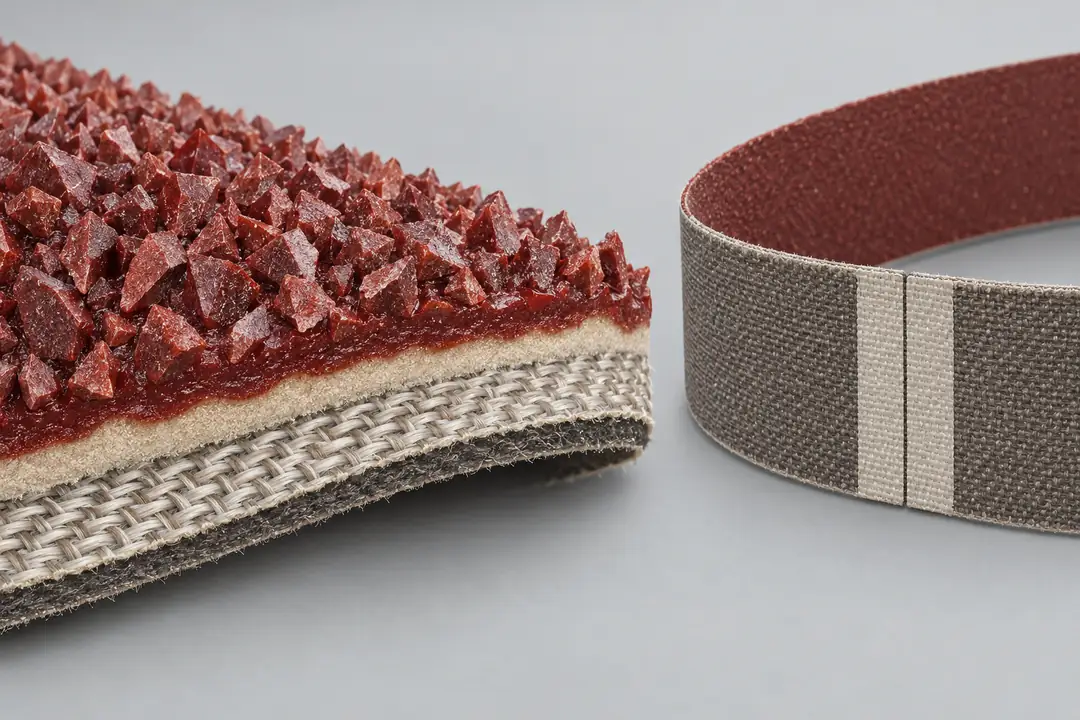
A sanding belt is a coated abrasive converted into an endless loop. Abrasive grains are anchored to paper, cloth, film or another backing by a maker coat and a size coat. The maker coat initially holds the grain; the size coat reinforces it and helps determine how firmly the abrasive remains attached during use. Some products add grinding aids, anti-static treatments or load-resistant top coats for a specific material or process.
The converter then slits the coated abrasive to width, cuts it to length and joins the ends. Dimensional tolerance, cut angle, skiving, adhesive, splice tape and curing affect whether the finished belt tracks correctly and crosses the contact zone without chatter or a visible joint mark. A technically suitable abrasive can still fail if conversion quality is inconsistent.
Industrial sanding belt selection starts with the workpiece and operation
Begin with the material grade, hardness and surface condition. Mild steel, stainless steel, aluminum, hardwood, glass and engineered stone do not produce the same chips or heat. The same belt may cut one material efficiently and load, glaze or discolor another.
Next define the operation. Heavy weld removal places different demands on a belt than scratch blending, calibration sanding or polishing. A small file belt sees frequent bending and limited cooling time. A wide belt on a platen may need low stretch and a very smooth joint. A slack-of-belt process requires conformability, while a serrated contact wheel concentrates pressure at the abrasive interface.
- Stock removal: how much material must be removed per part or pass?
- Contact: flat platen, hard or soft contact wheel, slack belt, narrow edge or contour?
- Finish: visual scratch pattern, Ra target, coating preparation or dimensional tolerance?
- Production: occasional manual work or continuous automated grinding?
- Heat limit: is burn, temper color, resin smearing or edge damage unacceptable?
- Environment: wet or dry, dust extraction, coolant, combustible dust and contamination limits?
Step 2: choose the abrasive grain
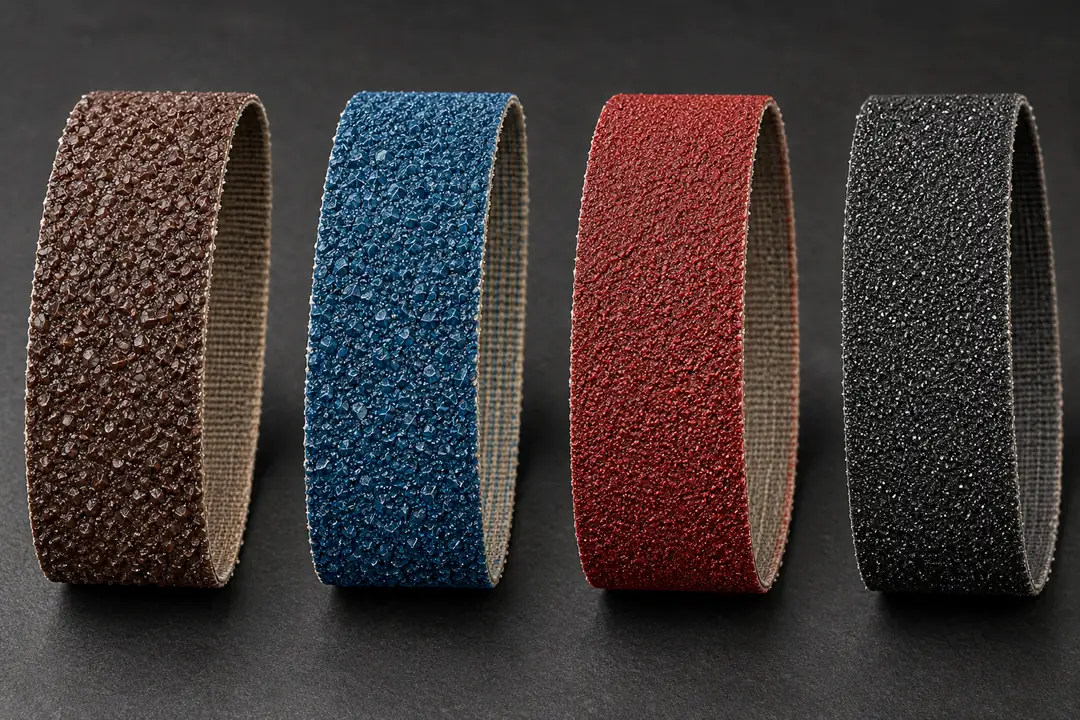
The four common grain families below are starting points. Product-level performance also depends on grain quality, blend ratio, treatment, shape and how the grain is bonded to the backing. For a broader explanation of abrasive behavior, see our abrasive materials guide.
| Grain | Typical starting applications | Why buyers choose it | Main caution |
|---|---|---|---|
| Aluminum oxide | General steel, wood, paint preparation and everyday sanding | Broad availability, versatile grades and economical performance | May lose cut sooner than premium grains in high-pressure production grinding |
| Zirconia alumina | Carbon steel, stainless steel, weld grinding, deburring and medium-heavy stock removal | Tough grain with controlled fracture under adequate pressure | Can glaze when pressure is too low to renew the cutting edges |
| Ceramic alumina | Stainless, tool steel, nickel alloys and high-productivity metal grinding | Microfracturing or shaped grains can maintain cutting points and support long life | Premium cost is justified only when machine power, pressure and process stability use the grain effectively |
| Silicon carbide | Glass, stone, ceramics, composites, non-ferrous metals and selected finishing operations | Very sharp and relatively friable cutting action | May break down too rapidly in heavy steel grinding |
Aluminum oxide for versatile, economical sanding
Aluminum oxide is often the safest baseline for general steel and woodworking. It is available in many purity levels and treatments, from flexible finishing belts to heavy cloth products. Use it when the process does not require the extra fracture behavior or heat resistance of a premium grain, or when a lower belt price is more valuable than maximum stock removal per changeover. See our small aluminum oxide sanding belts for compact machines.
Zirconia alumina for tougher metal grinding
Zirconia alumina is a common upgrade for weld removal, deburring and medium- to high-pressure metal grinding. The grain needs enough force to fracture and expose new edges. On a light finishing pass it may rub rather than self-sharpen, so do not choose zirconia solely because it is positioned above aluminum oxide. Our zirconia alumina belt page shows a typical metalworking format.
Ceramic alumina for demanding production work
Ceramic alumina and precision-shaped ceramic grains are used where cut rate, heat control and belt life can justify a higher purchase price. Typical targets include stainless steel, hardened or difficult alloys and repetitive industrial grinding. Performance varies with the specific ceramic technology; “ceramic belt” is not a complete specification. Pressure, speed and contact-wheel design must allow the grain to work as intended. See the WW950 ceramic sanding belt example.
Silicon carbide for sharp cutting and hard non-metallic materials
Silicon carbide fractures readily and produces sharp cutting points. It is widely considered for glass, ceramics, stone, composites, cast iron, non-ferrous materials and fine finishing. The final choice still depends on backing and coat: a belt intended for glass edging is not automatically suitable for finishing aluminum. Review loading tendency and lubrication before testing. Our silicon carbide belt page provides one compact-belt configuration.
Step 3: select the backing material and flexibility
The backing carries grinding force and must survive repeated flexing around the machine rollers. A heavier backing is not always better. Stiffness improves support for flat, high-pressure cutting, but too much stiffness prevents the belt from following contours and can increase edge cracking. A flexible backing conforms better but may stretch, tear or lose dimensional stability in a heavy operation.
| Backing family | Typical behavior | Common uses |
|---|---|---|
| Paper | Low stretch and economical; lighter weights are more flexible, heavier weights offer more support | Wide-belt woodworking, calibration and fine finishing on suitable machines |
| J-weight cloth | Light and flexible | Contours, profiles, slack-belt finishing and applications requiring conformability |
| X-weight cloth | General-purpose balance of strength and flexibility | Portable belts, backstands, intermediate belts and general metal or wood sanding |
| Y-weight polyester cloth | Strong, low-stretch and resistant to demanding use | Heavy stock removal, high pressure, wet-capable designs and large belts |
| Film or specialty backing | Consistent thickness and specialized flexibility or finish behavior | Precision finishing and application-specific systems |
J, X and Y are useful industry labels, but they do not guarantee identical tensile strength or flexibility across manufacturers. Ask for backing material, weight, flexibility treatment and wet-use suitability. Cotton is not inherently waterproof; polyester generally offers better water resistance, but the complete belt—including resin and joint—must still be approved for wet operation.
Step 4: consider open coat, closed coat and grinding aids
Coat density describes how closely abrasive grains cover the backing. A closed coat provides more cutting points and often supports aggressive cutting on materials that do not load the belt rapidly. An open or semi-open coat leaves more chip space and can reduce clogging on wood, aluminum, paint, filler and other loading-prone materials.
Grinding aids and load-resistant coatings serve different purposes. A grinding aid can reduce frictional heat and improve cutting on stainless steel or heat-sensitive alloys. A stearate or anti-loading treatment can help prevent chips, resin or paint from packing between grains. These features should be selected for the workpiece; they are not universal upgrades.
Step 5: choose the sanding belt joint
The joint must transmit belt tension while passing through the grinding zone. Joint terminology varies by manufacturer, so an RFQ should describe the construction and application rather than relying only on a supplier-specific code.
| Joint construction | How it is made | Where it is commonly considered | Selection risk |
|---|---|---|---|
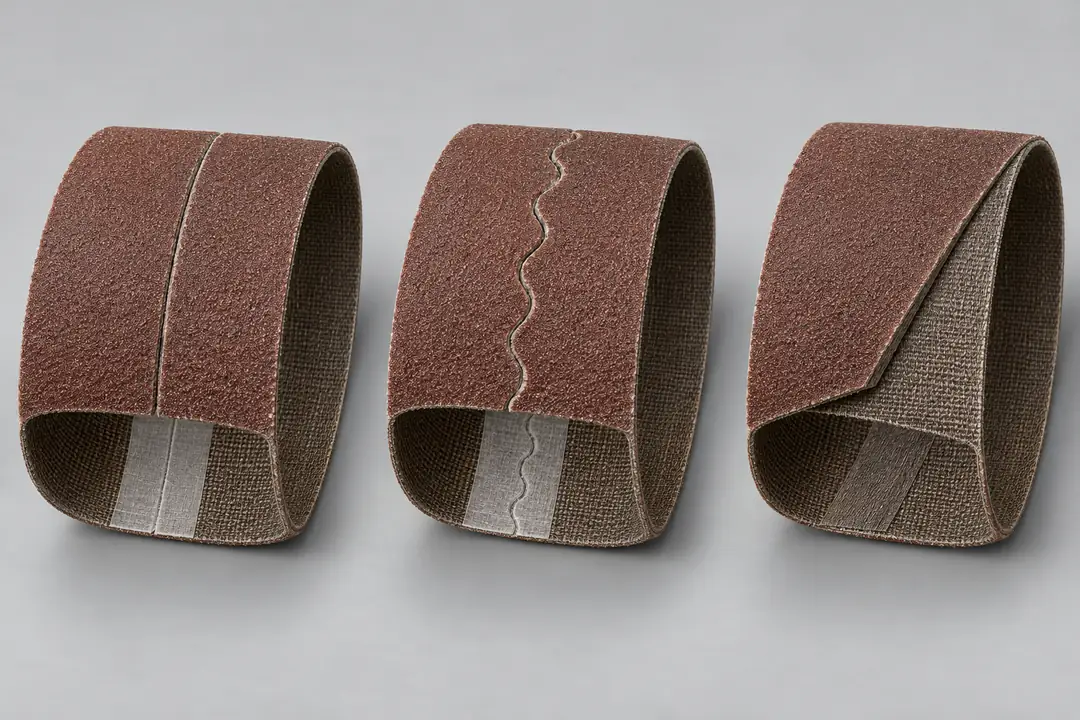
| Butt joint with backing tape | Belt ends meet without overlapping; high-strength tape reinforces the reverse | General cloth belts, portable belts, backstands and many bidirectional applications | Tape thickness and joint preparation can create chatter or a splice mark |
| Wave or zigzag butt joint | Interlocking or wave-cut ends are taped on the reverse | Applications seeking a gentler transition through the contact zone | Availability depends on belt width, grit and converter capability |
| Overlap or lap joint | One end overlaps the other; the upper flap may be partially or fully skived | Selected paper belts, wide belts and platen applications | Usually directional; excess joint thickness can mark the workpiece |
| Top-skived specialty joint | Grain or backing is reduced around the splice to minimize the step | Fine grits, hard platens, contours or operations sensitive to chatter | Too much skiving can reduce joint strength |
Always follow the direction arrow when the belt or joint is directional. If a belt leaves a regular line once per revolution, inspect the joint thickness, tape position, platen condition, contact-wheel runout and work pressure before changing grain or grit. The VSM and Klingspor references listed below show why joint construction is matched to backing and machine type.
Step 6: select the grit sequence
Coated abrasives commonly use FEPA P-grit designations. The “P” matters: FEPA distinguishes P-grits for coated abrasives from F-grits used for bonded abrasives. A grit number is a particle-size designation, not a direct prediction of surface roughness. Backing, grain shape, coat density, contact wheel, pressure, speed and previous scratches all change the finish.
| Typical grit range | Practical starting role | Questions before use |
|---|---|---|
| P24–P36 | Heavy stock removal, scale or aggressive dimensioning | Can the machine, backing and contact wheel safely apply enough power and pressure? |
| P40–P60 | Weld removal, deburring and general grinding | Will the scratch be removed economically by the next step? |
| P80–P120 | Blending, preparation and intermediate sanding | Is the objective a coating profile, cosmetic grain or preparation for finer grit? |
| P150–P240 | Fine finishing and scratch refinement | Will the belt load, generate heat or expose the joint mark? |
| P320 and finer | Very fine finishing, polishing preparation and specialty work | Are the previous scratches fully removed, and is a structured abrasive more consistent? |
Do not jump directly from a very coarse belt to a fine belt and expect the fine grain to erase deep scratches economically. Each step should remove the previous scratch pattern without consuming excessive belt life. Use the smallest number of steps that still achieves the target finish, and validate the sequence on the actual workpiece.
Step 7: match the belt to the machine and contact system
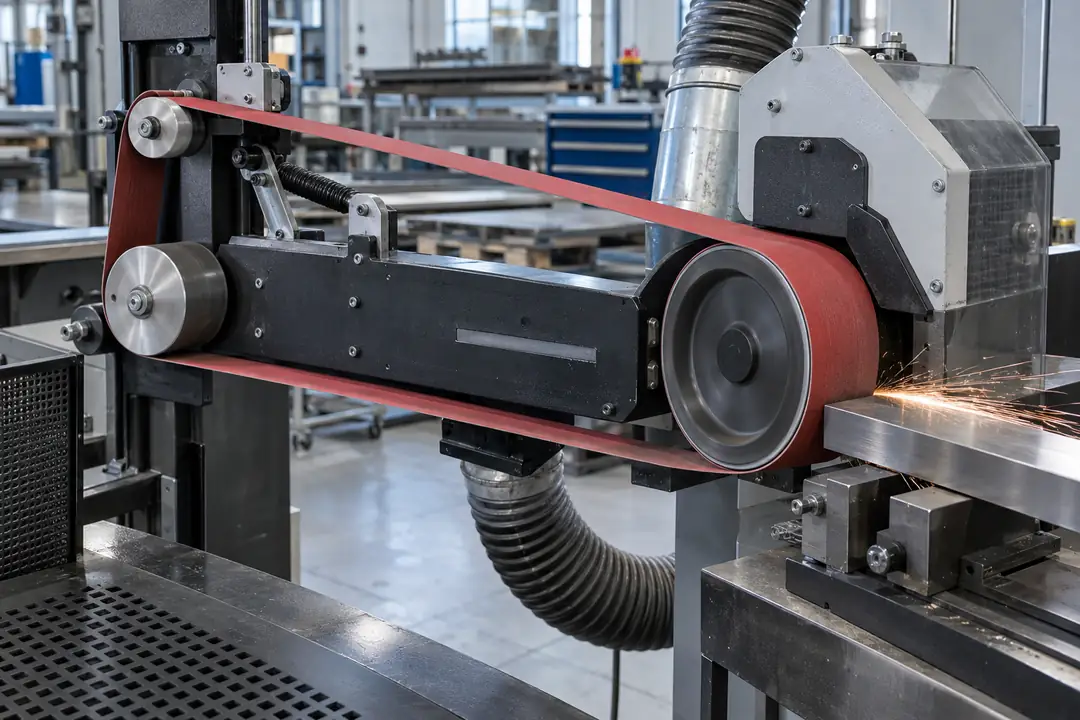
Belt performance cannot be separated from the machine. Confirm the exact inside circumference and width; “close enough” dimensions can cause tracking problems or prevent the tensioning system from reaching its working range. Record belt speed, motor power, tension, platen material, contact-wheel diameter, hardness, face pattern and dust or coolant system.
- Hard contact wheel or platen: concentrates support, increases cut and makes joint quality more visible.
- Soft contact wheel: improves conformability and can produce a finer apparent finish, but may reduce dimensional control.
- Serrated wheel: concentrates pressure and can increase cutting action while creating a more aggressive surface pattern.
- Slack-of-belt: conforms to contours but offers less geometric control and normally uses a flexible backing.
- Wide-belt machine: demands stable tracking, low stretch, controlled joint thickness and effective dust extraction.
- File or compact belt tool: subjects a short belt to frequent flexing and limited cooling time, increasing the importance of joint and backing durability.
Common sanding belt problems and what they indicate
| Problem | Likely causes to investigate | Practical first checks |
|---|---|---|
| Joint breaks | Wrong joint, excessive tension, small roller diameter, heat, contamination or incorrect running direction | Verify arrow, belt size, tension, roller diameter, joint age and storage |
| Belt tracks off | Incorrect dimensions, uneven tension, damaged backing, machine alignment or inconsistent splice | Check rollers, crown, tracking control, belt squareness and joint alignment |
| Rapid loading | Closed coat on a gummy material, insufficient extraction, excessive heat or wrong speed | Test open coat, anti-loading treatment, lower heat input, lubricant or better dust removal |
| Glazing and low cut | Grain too tough for the pressure, grit too fine, worn belt or low belt speed | Increase appropriate pressure, choose a more friable grain or return to a coarser grit |
| Burn or discoloration | High friction, dull grain, excessive pressure, poor coolant or insufficient chip clearance | Review grain, grinding aid, speed, contact area, coolant and belt-change point |
| Regular line or chatter | Joint step, tape, hard platen, wheel runout or vibration | Mark the belt revolution, inspect splice thickness and check machine runout |
| Edge fraying | Misalignment, edge contact, incorrect width, weak backing or poor slitting | Inspect tracking and guards; verify converted width and edge quality |
Compare belts by cost per accepted part
Unit price is an incomplete buying metric. A premium ceramic belt may be uneconomical on a low-pressure operation, while a lower-priced aluminum oxide belt can become expensive if it requires frequent changes or produces inconsistent finishes. Run a controlled trial with the same machine, operator or automation program, workpiece batch and acceptance criteria.
- Record initial belt price and setup time.
- Measure material removed or parts completed at defined intervals.
- Track belt changes, dressing or cleaning, and machine downtime.
- Inspect surface finish, dimensions, burn, loading and rework.
- Stop each belt at the same agreed performance threshold.
- Calculate abrasive cost, labor, downtime and scrap per accepted part.
Do not compare one new belt with another belt already near the end of its life. If possible, repeat the test to separate product performance from operator and workpiece variation.
Industrial sanding belt RFQ checklist
A useful RFQ lets the supplier recommend a construction rather than merely quote the nearest catalog item. Include the following information:
- Workpiece material, grade, hardness, coating and current surface condition
- Operation: dimensioning, weld removal, deburring, blending, finishing or polishing preparation
- Machine make and model, belt speed, power, tension system and wet/dry operation
- Exact belt width × inside length, quantity per size and acceptable dimensional tolerance
- Contact wheel or platen type, diameter, hardness and face pattern
- Required stock removal, cycle time, finish, tolerance and defect limits
- Preferred grain, grit range, backing and joint—or permission for the supplier to propose alternatives
- Current belt code and the reason for changing: life, cut, heat, loading, joint, tracking or price
- Dust extraction, coolant, lubricant and contamination restrictions
- Trial quantity, packaging, labeling, batch traceability and private-label requirements
For non-standard widths and lengths, see our custom wide cloth sanding belts and the complete industrial sanding belt range.
Frequently asked questions
What is the best sanding belt grain for metal?
There is no single best grain. Aluminum oxide is a versatile economical baseline; zirconia alumina suits many medium- and heavy-duty steel operations; ceramic alumina is often selected for high-productivity grinding of stainless and difficult alloys. Pressure, belt speed, backing and grinding aid can change the result.
Which backing is best for a sanding belt?
Use a flexible backing for contours and a stronger, stiffer backing for flat or high-pressure work. J-weight cloth is commonly associated with flexibility, X-weight with general-purpose use and Y-weight polyester with demanding low-stretch applications. Confirm the supplier’s actual backing specification rather than relying on the letter alone.
Is a butt joint better than an overlap joint?
Neither is universally better. A taped butt joint is widely used on cloth belts and can run smoothly in one or both directions depending on design. An overlap joint may suit selected paper or wide-belt applications. Machine geometry, platen hardness, backing and finish requirement should determine the joint.
What grit should I use for weld removal?
P36 to P60 is a common starting range, but weld size, material, contact wheel and required next finish matter. Choose the coarsest grit that removes the weld efficiently without creating unnecessary damage or extra finishing steps.
Why does a sanding belt keep breaking at the joint?
Possible causes include the wrong joint, excessive belt tension, a roller diameter that is too small for the backing, heat, contamination, expired adhesive, poor storage or running a directional joint backward. Check the machine and belt specification before concluding that the abrasive grain is defective.
Can the same sanding belt be used wet and dry?
Only when the complete belt construction is approved for both. The backing, resin, splice tape and adhesive must tolerate the coolant or water. Do not assume that a water-resistant polyester backing makes every joint or coating wet-compatible.
Select the complete belt, not one specification line
A reliable industrial sanding belt selection combines the workpiece, grain, backing, coat, joint, grit and machine. Start with a technically reasonable construction, then confirm it through a controlled trial. The best result is the belt that meets the cut and finish requirement consistently while reducing changeovers, rework and total cost per accepted part.
Send us the workpiece material, application, belt size, machine, speed, contact system, current grit and performance problem. Request an industrial sanding belt recommendation and quotation.