Grinding wheel abrasive materials determine how a wheel cuts, how quickly it wears and which workpiece materials it can process efficiently. Aluminum oxide remains the general starting point for many steels, silicon carbide is commonly used for cast iron, non-ferrous metals and non-metallic materials, ceramic alumina is selected when high stock removal and controlled self-sharpening are required, CBN is used mainly for hardened ferrous materials, and diamond is normally preferred for carbide, ceramics, glass and other hard, brittle non-ferrous materials.
The abrasive grain is only one part of the specification. Bond type, grit size, grade, structure, porosity, concentration, wheel shape, operating speed and dressing method all change the result. A technically correct selection therefore starts with the workpiece and the grinding operation—not with the assumption that the hardest or most expensive abrasive must be the best.
Quick answer: use aluminum oxide as a broad starting point for steels, silicon carbide for many cast-iron, non-ferrous and non-metallic applications, ceramic alumina for demanding production grinding, CBN for hardened steels and other suitable ferrous materials, and diamond for carbide, ceramics, glass and similar hard, brittle materials. Confirm the final wheel specification through a controlled grinding trial.
| Abrasive material | Typical workpiece fit | Primary advantage | Main selection caution |
|---|---|---|---|
| Aluminum oxide | Carbon steel, alloy steel and many general ferrous applications | Versatile, economical and available in many grain variants | The correct alumina type and friability still depend on hardness, contact area and stock removal |
| Silicon carbide | Cast iron, non-ferrous metals, glass, stone and selected non-metallic materials | Sharp cutting edges and relatively friable behavior | Can break down too quickly in applications that require a tougher grain |
| Ceramic alumina | Production grinding of steels and difficult-to-grind ferrous materials | Microfracturing grain can maintain cutting edges under suitable pressure | Ceramic alumina is an abrasive grain, not the same thing as a vitrified bond |
| CBN | Hardened steel, HSS, bearing steel, tool steel and selected heat-resistant alloys | High wear resistance and good thermal performance in many ferrous grinding operations | Not automatically suitable for soft, ductile or loading-prone steels |
| Diamond | Cemented carbide, technical ceramics, glass, stone, composites and silicon carbide | Extreme hardness and wear resistance | Usually not the first choice for hardened ferrous materials because chemical wear can accelerate at grinding temperatures |
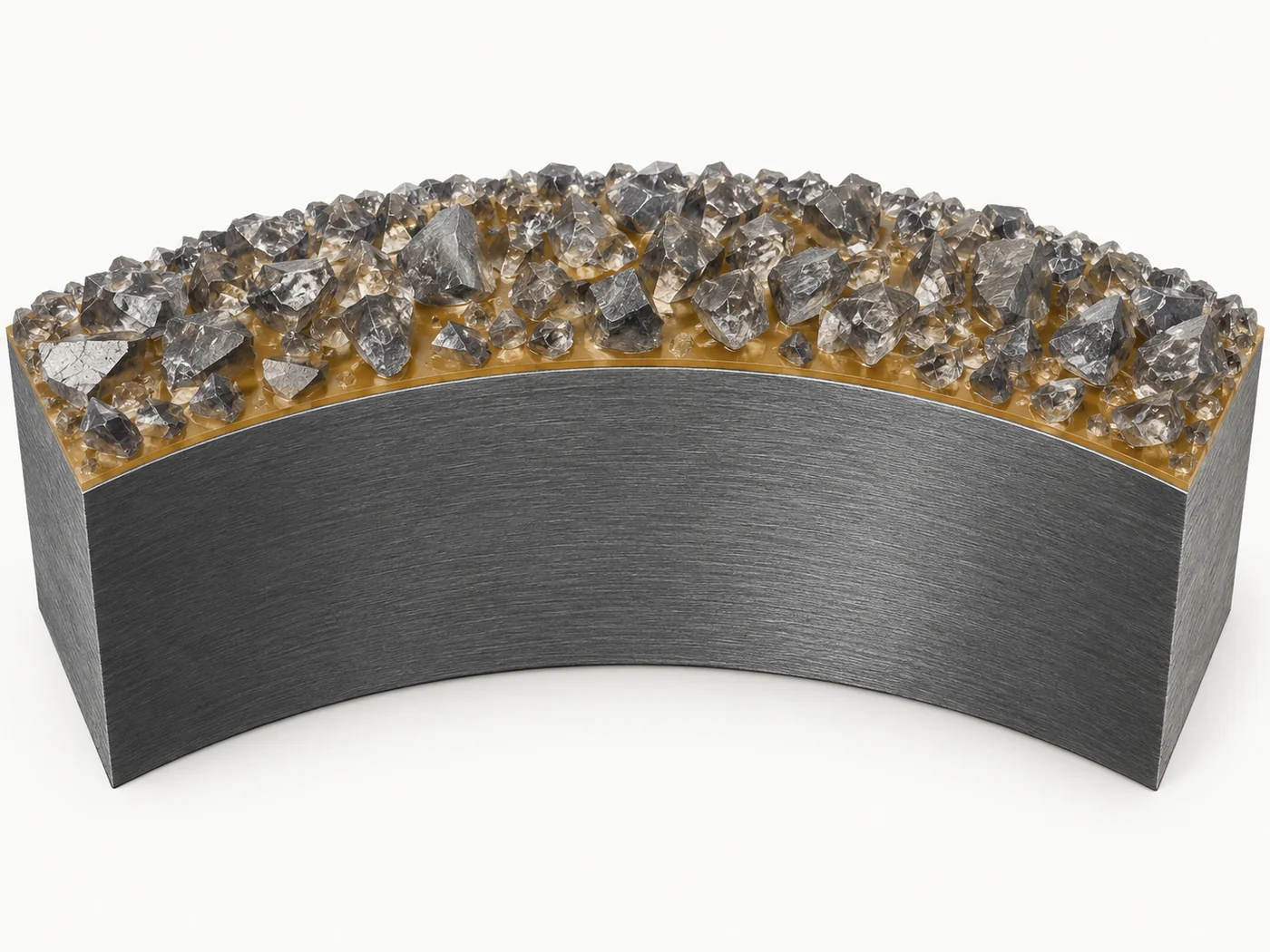
What a grinding wheel is made of
A bonded grinding wheel contains three functional elements: abrasive grains that form the cutting edges, a bond that holds those grains, and voids or pores that provide chip space and coolant access. Superabrasive wheels may place a relatively thin diamond or CBN layer on a steel, aluminum, resin or other engineered core rather than making the complete wheel from abrasive material.
This distinction matters because terms that sound similar may describe different parts of a wheel. Ceramic alumina normally describes a microcrystalline aluminum-oxide abrasive grain. Vitrified bond describes a glass-like bonding system. A vitrified CBN wheel therefore uses CBN abrasive held by a vitrified bond; it does not use ceramic alumina as its cutting grain. Norton provides the same grain–bond–porosity framework in its grinding wheel basics.
From natural stones to engineered abrasive wheels
Grinding developed from the use of naturally occurring stones and loose abrasive particles into a controlled machining process. Early abrasive tools depended on natural grain quality, so cutting behavior and wheel life varied widely. Industrial production created demand for abrasives with repeatable chemistry, particle size and fracture behavior, leading to the broad adoption of manufactured aluminum oxide and silicon carbide.
Modern wheels are engineered rather than simply formed from a hard mineral. Grain microstructure can be designed to fracture at a controlled scale, bond chemistry can balance retention with self-sharpening, and porosity can be adjusted for chip clearance and coolant delivery. CBN and synthetic diamond extended grinding into materials where conventional abrasives may wear too quickly or struggle to maintain geometry. More recent research investigates shaped grains, controlled pore networks, additive manufacturing and internal coolant channels.
Aluminum oxide grinding wheels
Aluminum oxide is the most familiar conventional abrasive for grinding steels. Corundum is commonly placed at about 9 on the Mohs scale, but hardness alone does not explain performance. Grain purity, crystal structure, shape, toughness and friability influence how the cutting edge wears and renews itself. Brown, white, pink, monocrystalline and engineered aluminum-oxide grains can therefore behave differently even when they share the same general chemistry.
Tougher aluminum-oxide grains can withstand heavier forces and make economical use of the grain in general-purpose or high-stock-removal work. More friable grains fracture more readily and can expose fresh cutting edges under lighter grinding pressure. The correct choice depends on workpiece hardness, contact area, machine power, coolant, required finish and the amount of material to be removed.
Silicon carbide grinding wheels
Silicon carbide is a very hard, sharp and comparatively brittle conventional abrasive. Its grain tends to fracture and renew sharp edges, which makes it useful for many cast-iron, non-ferrous and non-metallic materials. Common applications include gray iron, carbide-tool support operations, glass, ceramics, stone and selected aluminum or copper alloys, although loading and wheel structure must be considered for soft metals.
Silicon carbide should not be described simply as “better cutting” than aluminum oxide. Its greater friability can be an advantage when a sharp cutting action is needed, but it can also reduce wheel life if the grain breaks down faster than the operation requires. Material, hardness and grinding pressure should determine whether sharpness or toughness is the more valuable property.
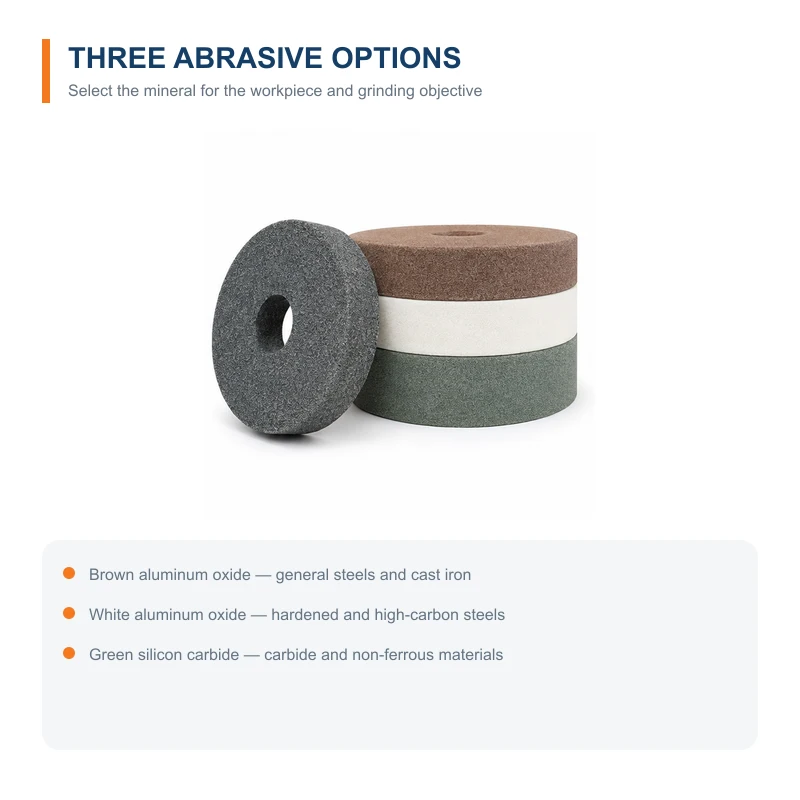
Ceramic alumina is a grain—not a bond type
Ceramic alumina, sometimes described as seeded-gel, sol-gel or microcrystalline alumina, is an engineered aluminum-oxide grain. Instead of wearing into one broad flat surface, a properly applied ceramic grain can microfracture and continuously expose smaller cutting edges. This can support high material-removal rates, controlled grinding forces and longer useful cutting life in production grinding.
The grain still needs sufficient force to self-sharpen. On a light, low-power or highly compliant process, a very tough ceramic grain may rub instead of fracturing as intended. Ceramic alumina may be blended with conventional aluminum oxide to balance cutting behavior, wheel life and cost. It can also be held in different bond systems; calling every ceramic-grain wheel a “ceramic-bond wheel” confuses two separate specification decisions.
CBN grinding wheels for hardened ferrous materials
Cubic boron nitride is a superabrasive used primarily when hardened ferrous materials must be ground with stable geometry and controlled wear. Typical starting applications include hardened bearing steel, tool steel, high-speed steel, case-hardened gears, camshafts, crankshafts and selected heat-resistant alloys. Compared with diamond, CBN offers better chemical stability in many high-temperature iron-rich grinding conditions.
CBN is not automatically the correct choice for every steel. A relatively soft or ductile steel can load the wheel, and a machine without sufficient rigidity, speed capability, coolant delivery or dressing equipment may not realize the benefit of a premium abrasive. Buyers should select the grain, bond and pore structure around the whole process. Our CBN grinding wheel buyer guide covers material and bond selection in detail, while the CBN grinding wheel setup guide explains mounting, truing, dressing and coolant control.
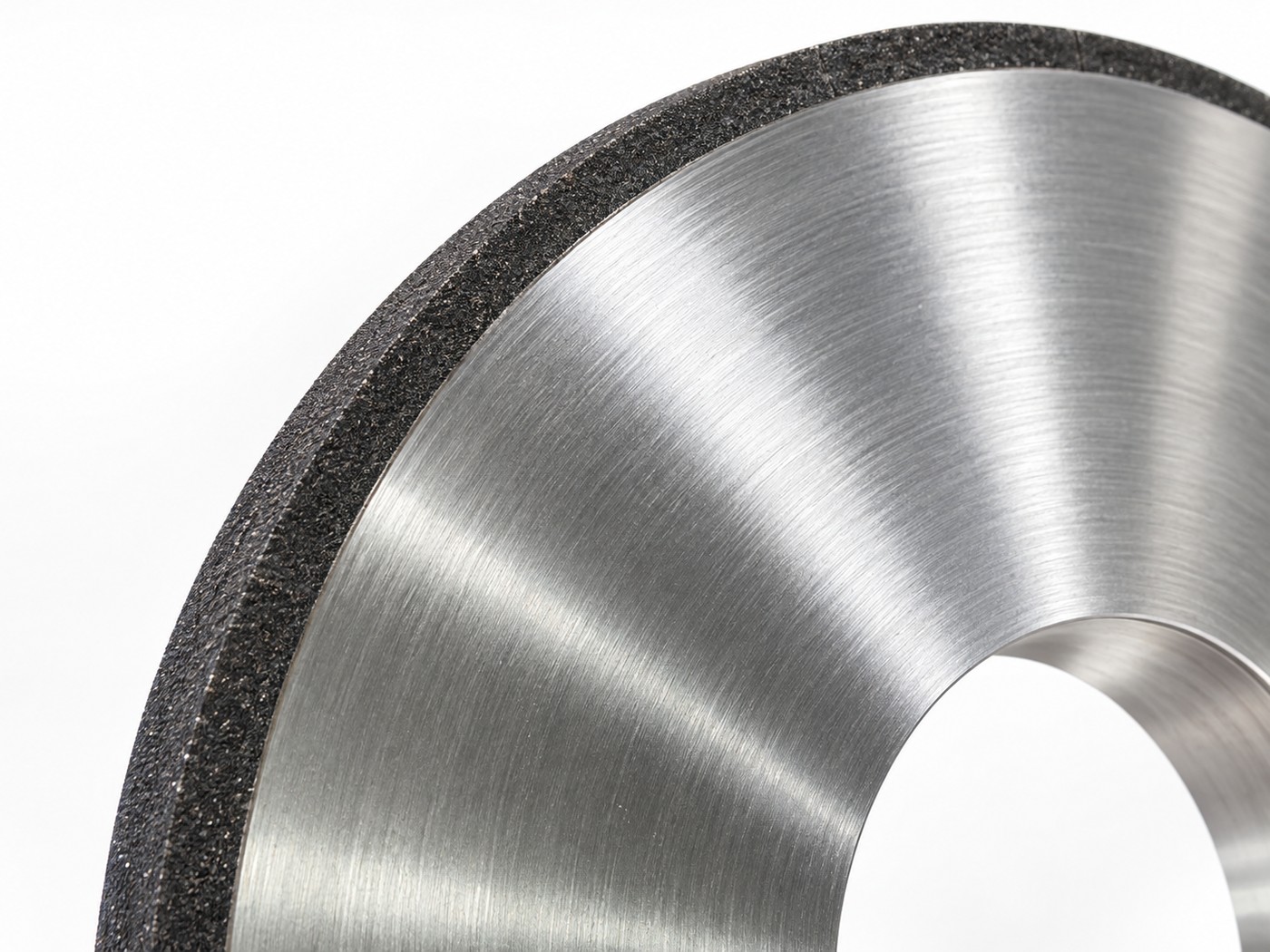
Diamond grinding wheels for hard, brittle materials
Diamond is the hardest widely used abrasive and can maintain sharp cutting edges when grinding cemented carbide, technical ceramics, glass, stone, quartz, composites and silicon carbide. Grain size, concentration and bond system can be engineered for work ranging from aggressive stock removal to precision tool grinding and fine finishing.
Its hardness does not make it universal. At grinding temperatures, diamond can experience accelerated chemical wear against iron-rich materials, so CBN is normally the more appropriate superabrasive starting point for hardened steels. Thermal behavior also depends on the complete wheel and process. A diamond wheel does not automatically run cool or resist loading; bond, structure, speed, infeed, contact length, dressing and coolant delivery remain decisive.
For carbide and tool-grinding applications, compare wheel shape, abrasive-layer dimensions and bond behavior rather than purchasing by the word “diamond” alone. See our diamond grinding wheel range and the detailed PCD vs CBN cutting tool guide when the application concerns defined-edge cutting tools rather than bonded abrasive wheels.
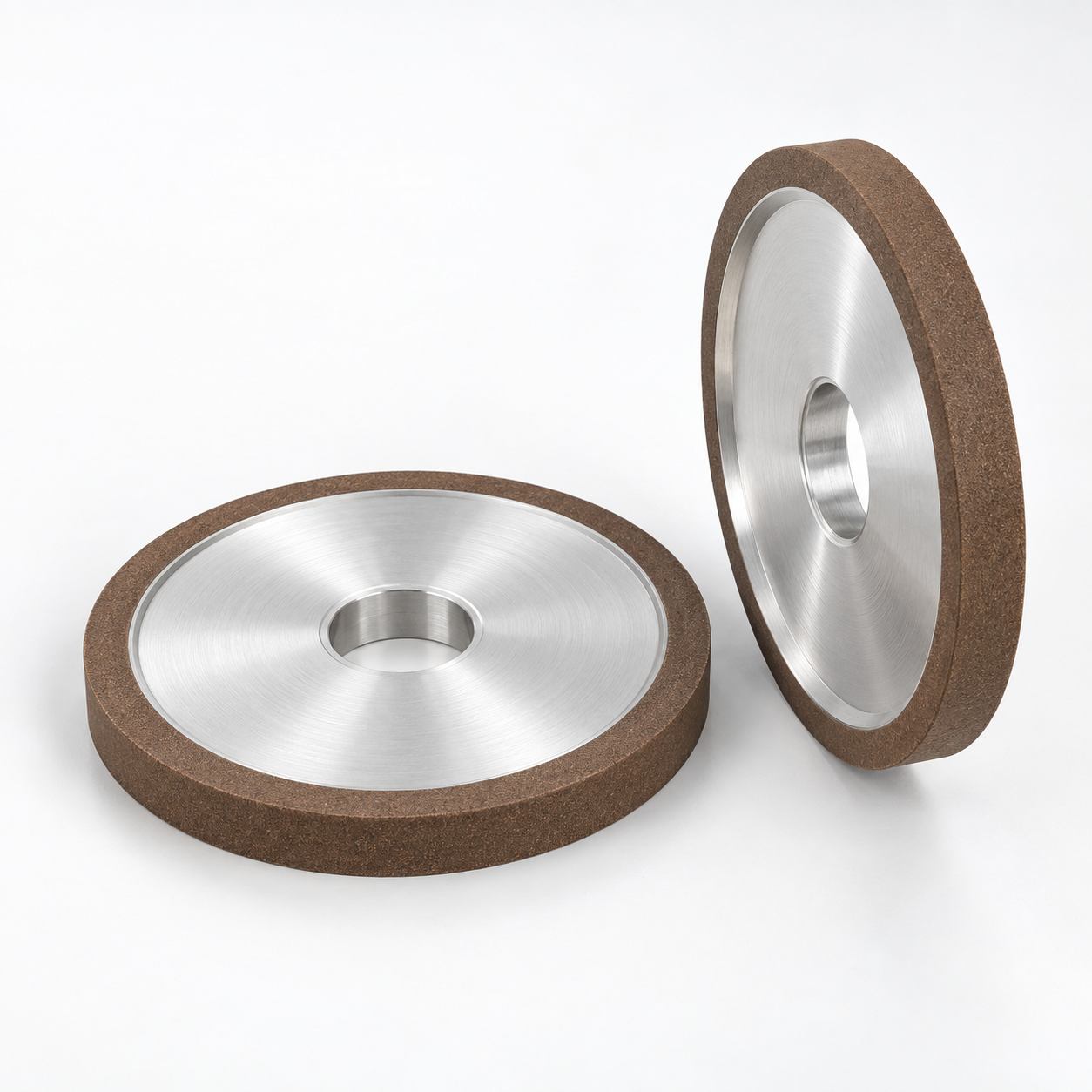
How bond type changes wheel performance
The bond holds abrasive grains, transfers grinding force and controls how worn grains are released or exposed. Bond selection changes form retention, cutting freedom, impact resistance, heat response, porosity and dressing requirements. The descriptions below are starting points, not substitutes for an application-specific wheel recommendation.
| Bond system | Typical behavior | Common selection questions |
|---|---|---|
| Vitrified bond | Rigid, dressable and able to use engineered porosity; common in precision production grinding | Is rotary dressing available? How much coolant access and profile retention are required? |
| Resin bond | Relatively compliant cutting action with broad use in tool grinding, cut-off and finishing | What finish, heat sensitivity, support and dressing method does the operation require? |
| Metal bond | Strong grain retention and form stability, often with more specialized conditioning needs | Can the machine manage loading, power demand and the required conditioning method? |
| Electroplated | Single abrasive layer with high grain protrusion and the ability to reproduce complex forms | Is a non-dressable or re-platable single-layer tool acceptable for the production plan? |
Grit size, grade, structure and concentration
Grit size describes abrasive particle size. Coarser grit generally provides larger chip space and more aggressive stock removal, while finer grit normally supports a finer finish and smaller edge features. The relationship is not one-dimensional: dressing condition, workpiece material and process stability can make a fine wheel cut poorly or a coarser wheel produce an acceptable finish.
For diamond and CBN products, very fine grit designations are not always directly interchangeable across manufacturers. A.L.M.T. notes that JIS B 4130 standardizes the relevant superabrasive sizes through #325, while manufacturers may use their own systems for finer sizes. Buyers comparing fine wheels should therefore request the actual particle-size range rather than assuming that two products marked #10000 are identical. See the manufacturer’s grinding wheel specification reference.
Grade describes the wheel’s relative ability to retain abrasive grains; letter grades such as N are designations, not physical units. A harder grade holds grain more strongly, while a softer grade releases it more readily, but identical letters from different manufacturers should not be assumed to produce identical behavior. Structure describes the spacing among grains and available void space. A more open structure can improve chip clearance and coolant access, while a denser structure places more cutting points in the contact zone.
Concentration describes the diamond or CBN content in the abrasive layer. In the conventional superabrasive concentration system, concentration 100 corresponds to approximately 4.4 carats of abrasive per cubic centimetre, commonly associated with about 25% abrasive by volume. It is not 4.4 cc/cm³. Higher concentration provides more abrasive grains but does not automatically provide a faster or better cut. Single-layer electroplated wheels generally do not use the same concentration system.
How to select grinding wheel abrasive materials by application
| Application or material | Practical starting abrasive | What to verify before ordering |
|---|---|---|
| General cylindrical or surface grinding of steel | Aluminum oxide or an alumina blend | Steel grade and hardness, contact area, stock removal, finish and coolant |
| High-productivity grinding of hardened or difficult steel | Ceramic alumina or CBN, depending on hardness, machine and economics | Machine rigidity, dressing capability, batch volume, burn inspection and cost per accepted part |
| Bearing races, gears and hardened shafts | CBN or application-specific ceramic alumina | Heat treatment, profile, dressing interval, surface integrity and dimensional drift |
| Gray cast iron | Silicon carbide, aluminum-oxide blends or application-specific CBN | Iron type, hardness, graphite structure, production volume and wheel-loading behavior |
| Cemented carbide cutting tools | Diamond | Carbide grade, wheel shape, edge quality, bond and wet/dry process |
| Technical ceramics, glass or silicon carbide | Diamond | Brittleness, chipping limit, subsurface damage, coolant and target finish |
| Soft or gummy non-ferrous metal | Often silicon carbide or a specially structured conventional abrasive | Loading tendency, lubrication, open structure and allowable surface condition |
A selection table narrows the starting point; it does not define a finished specification. Two operations grinding the same alloy may require different wheels because one is a broad surface contact with light infeed while the other is a narrow profile with heavy stock removal. Wheel speed, work speed, infeed, coolant, dressing and machine stiffness can change which abrasive performs economically.
Structured abrasives and internally cooled grinding wheels
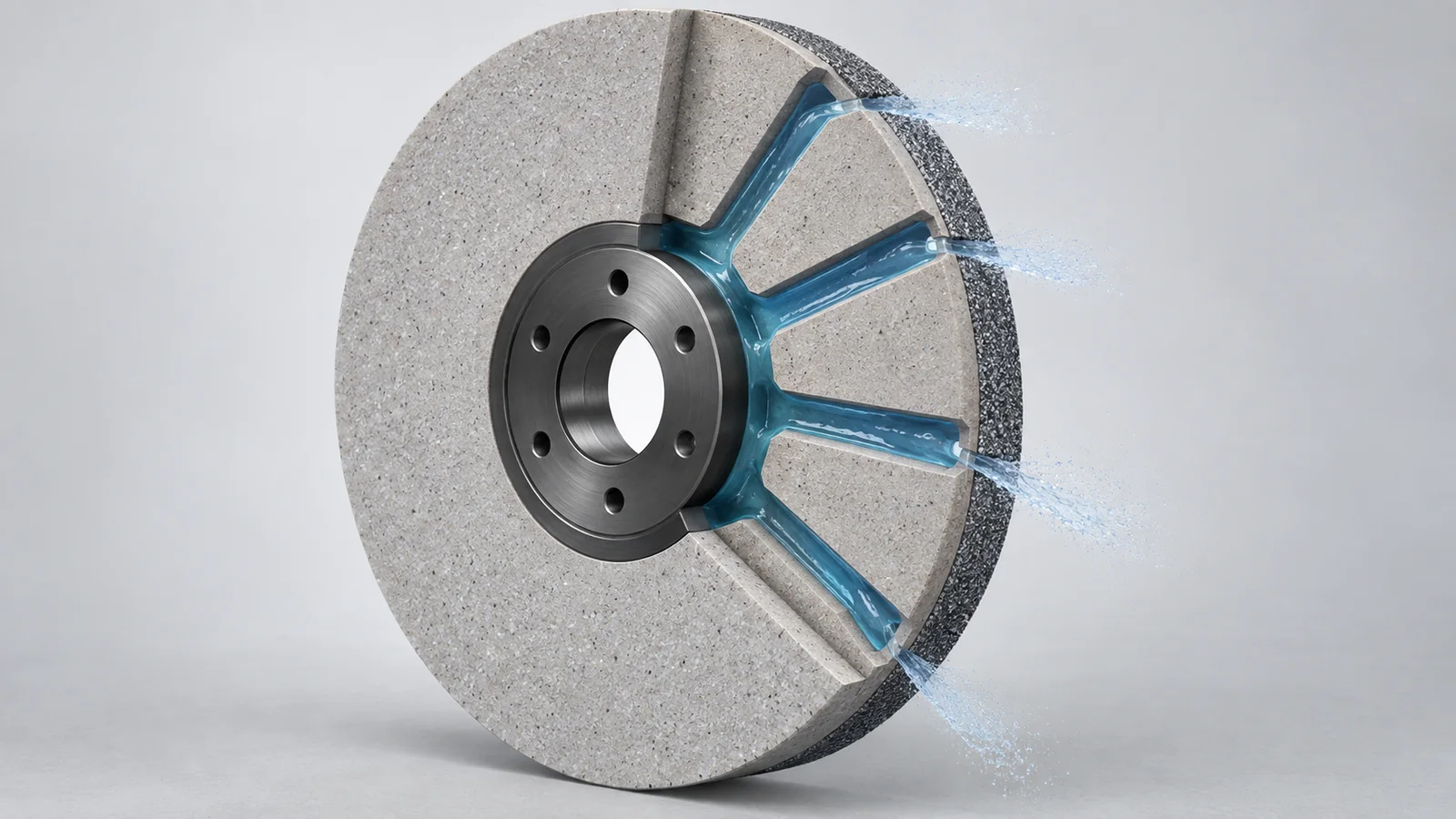
New grinding-wheel development focuses not only on harder grains but also on controlling where grains and pores are placed. Shaped or engineered grains can create more predictable cutting points. Designed pore networks can provide chip space without sacrificing all of the wheel’s mechanical support. Additive and sacrificial manufacturing methods also make it possible to investigate internal channels that deliver coolant closer to the grinding zone.
A 2024 laboratory study titled A New Grinding Wheel Design with a 3D Internal Cooling Structure System tested wheels containing different channel geometries. Under that study’s specific test conditions, the hexagonal design reduced disc wear rate by 64% and improved the reported grinding ratio compared with the unstructured reference. These results show the potential of internal coolant delivery, but they should not be treated as guaranteed commercial performance for every wheel, material or grinding machine. Broader industrial validation is still required.
What to include in a grinding wheel RFQ
“Aluminum oxide wheel,” “CBN wheel” or “diamond wheel” is not enough information for a reliable quotation. A supplier needs to understand the complete process before recommending grain, grit, grade, structure, bond and abrasive-layer geometry.
- Workpiece material, grade, hardness, heat treatment and coating
- Grinding operation: surface, OD, ID, centerless, creep feed, gear, profile, tool or cut-off
- Wheel shape, outside diameter, thickness, bore and abrasive-layer dimensions
- Machine make and model, spindle power, RPM range and mounting system
- Stock allowance, contact area, feed, infeed and production volume
- Required tolerance, roundness, profile, edge quality and surface finish
- Wet or dry process, coolant type, concentration, filtration and nozzle arrangement
- Available truing and dressing equipment and current dressing parameters
- Existing wheel code, accepted parts per wheel, cycle time and current defect
- Inspection requirements for burn, residual stress, chipping or subsurface damage
This information allows suppliers to compare technical alternatives on cost per accepted part rather than wheel price alone. A lower-priced conventional wheel may be correct for a flexible, low-volume operation, while a more expensive ceramic or superabrasive wheel can be economical when it reduces dressing, changeovers, dimensional drift or scrap.
Frequently asked questions
What are the five main grinding wheel abrasive materials?
The principal groups covered in industrial wheel selection are aluminum oxide, silicon carbide, ceramic alumina, CBN and diamond. Zirconia alumina and abrasive blends are also important in specific wheel and coated-abrasive applications.
Is ceramic alumina the same as a vitrified bond?
No. Ceramic alumina is an engineered abrasive grain. Vitrified bond is a glass-like material that holds abrasive grains together. A wheel may use ceramic alumina grain in a vitrified bond, but the terms describe different parts of the specification.
Should hardened steel be ground with diamond or CBN?
CBN is normally the preferred superabrasive starting point for hardened ferrous materials because it offers better chemical stability than diamond in many iron-rich grinding conditions. Diamond is generally preferred for cemented carbide, ceramics, glass and other hard, brittle non-ferrous materials.
Does a finer grit always produce a better finish?
No. Finer grit can support a finer finish, but a wheel that loads, rubs or is dressed incorrectly may create heat and poor surface integrity. Grit must be selected with bond, structure, dressing, workpiece material and grinding parameters.
Is the hardest abrasive always the most economical?
No. The correct abrasive is the one that produces accepted parts consistently on the available machine. Purchase price, dressing time, cycle time, wheel changes, scrap, surface integrity and operator intervention should be included in the comparison.
Choose the wheel around the complete grinding process
Grinding wheel abrasive materials provide the cutting edges, but they do not work independently. Aluminum oxide, silicon carbide, ceramic alumina, CBN and diamond each have a useful application range. Bond, grit, grade, structure, concentration, dressing, coolant and machine capability determine whether that potential becomes a stable production process.
If you are comparing a conventional, CBN or diamond wheel, send the workpiece grade and hardness, operation, wheel dimensions, machine and RPM, stock removal, tolerance, finish, coolant and dressing method. Request a grinding-wheel specification review and quotation.