Choose resin bond for controlled finishing, metal bond for wear and profile retention, vitrified bond for porous and dressable precision grinding, electroplated bond for a sharp single-layer form, and brazed bond for aggressive exposed-grain tools. The final choice depends on the workpiece, contact area, coolant, machine power, finish target and dressing plan.
What Does the Bond Do in a Diamond Grinding Wheel?
The bond holds diamond grains in the abrasive layer and controls when worn grains remain in place or release. That behaviour affects cutting force, heat, chip clearance, profile retention, wheel wear and the ability to restore the cutting surface by dressing.
Bond choice cannot be separated from grit size and concentration. A fine grit in a dense, wear-resistant bond can load if the process does not provide enough chip clearance. A coarser grit in a more compliant bond may cut freely but lose profile sooner. Wheel shape, abrasive-layer thickness and contact area change the result again.
For this reason, the best bond is not simply the hardest or longest-lasting option. It is the bond that keeps the wheel cutting while meeting the required geometry, finish and cycle time at an acceptable dressing interval.
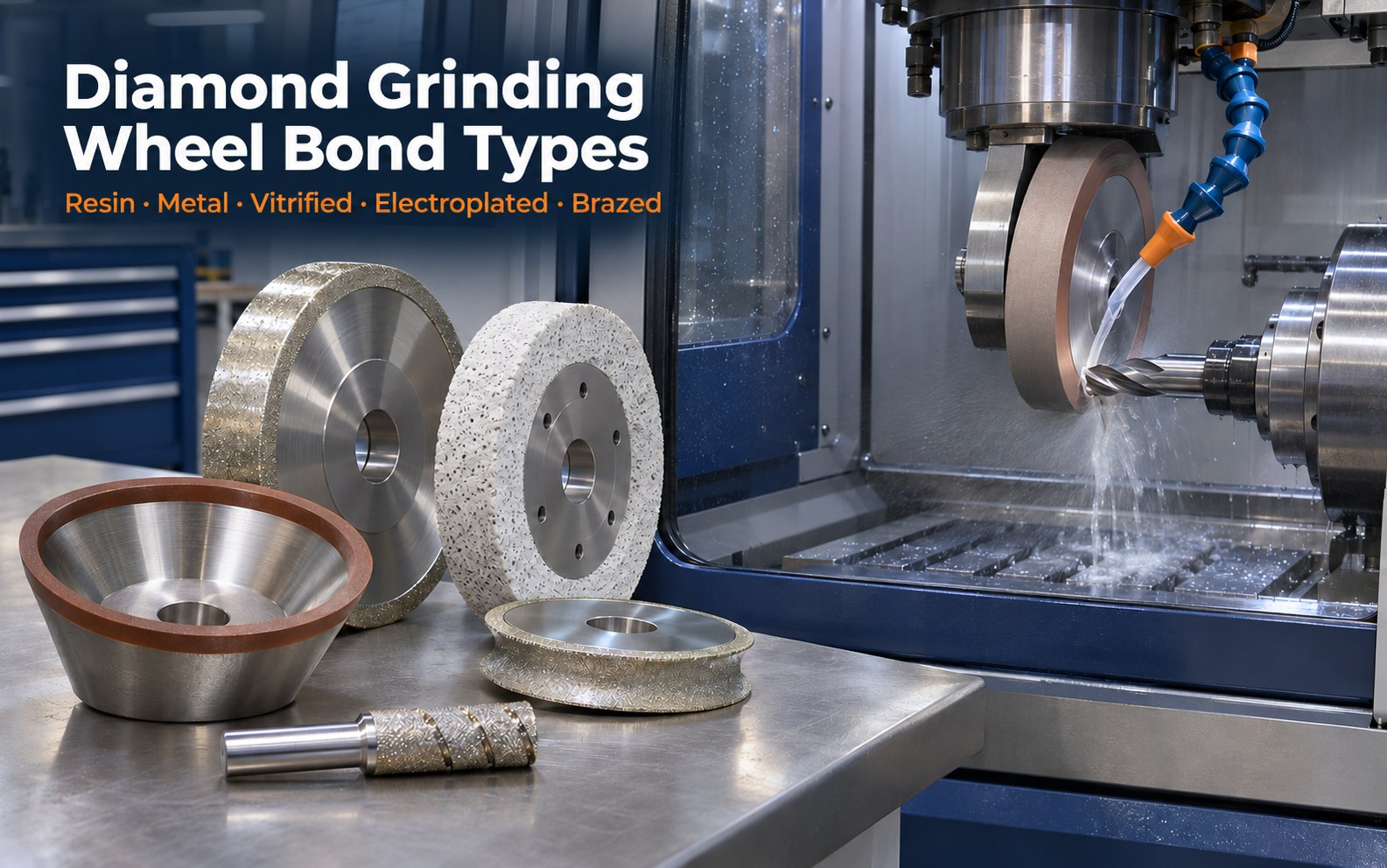
How Do the Main Diamond Grinding Wheel Bond Types Compare?
The following table combines the supplier catalogue’s five bond families with practical purchasing considerations. “Metal bond” includes bronze-bond systems. Electroplated and brazed tools are shown separately because both are usually single-layer tools with different grain-retention mechanisms.
| Bond type | Main process tendency | Typical strengths | Main limitations | Common starting applications |
|---|---|---|---|---|
| Resin | Compliant, free-cutting finishing | Lower grinding force, good finish potential, adaptable formulations | Usually lower profile retention and wheel life than dense metal systems | Carbide tool grinding, glass and ceramic finishing, precision wet or dry grinding |
| Metal / bronze | Rigid, wear-resistant multilayer grinding | Long wear life, strong grain retention, good form holding | Can load or become dull; dressing may be more demanding | Glass, ceramics, ferrite, carbide, edge grinding, cut-off and form retention |
| Vitrified | Porous and dressable precision grinding | Chip space, coolant access, controlled self-sharpening, profile correction | More brittle than resin or metal; application and speed limits must be confirmed | Precision CBN grinding of hardened steel; selected diamond grinding of hard-brittle materials |
| Electroplated | Sharp single abrasive layer | High grain protrusion, complex profiles, no routine dressing | Once the layer is worn, it is normally replated or replaced; finish changes with wear | Mounted points, internal forms, grooves, small tools and profile grinding |
| Brazed | Aggressive single layer with high grain exposure | Strong individual grain retention, open cutting face, good access for chips | Not normally dressable; finish and force depend strongly on grain size and exposure | Aggressive stock removal, complex surfaces and hard-brittle material machining |
This is a selection map, not a performance guarantee. A bond family contains many formulations. Two resin-bond wheels from different suppliers can differ in filler, elasticity, porosity, cure, concentration and diamond coating, so they should not be treated as interchangeable.

When Should You Choose a Resin-Bond Diamond Wheel?
Resin bond is a practical starting point when the buyer needs controlled cutting force and a good surface or edge finish. Its relative compliance can absorb part of the vibration and side load that would otherwise transfer directly to a brittle workpiece or thin cutting edge.
The supplier catalogue recommends resin-bond tools for fine grinding and polishing and notes their good surface-quality potential. This aligns with common use in tungsten-carbide tool grinding, where burn control, edge chipping and finish are often more important than maximum profile life. Our resin-bond diamond cup grinding wheels are an example of this application family.
Resin bond is not automatically the coolest or best-finishing solution. A wheel that is too hard, too fine or insufficiently dressed can still glaze and generate heat. Record spindle load, edge condition, Ra, cycle time and dressing interval during the trial rather than judging the first part only.
Use resin bond as a first trial when:
- the workpiece is cemented carbide, technical ceramic, glass or another hard non-ferrous material;
- the operation is tool face, flute, edge or profile finishing;
- moderate compliance is useful for reducing force or vibration;
- the wheel must balance stock removal with finish; or
- wet and dry variants need to be evaluated for the actual machine.
When Is Metal or Bronze Bond the Better Choice?
Metal-bond diamond wheels retain abrasive strongly and resist wear. This makes them useful when geometry and abrasive-layer life matter more than easy self-sharpening. Bronze-bond wheels are a metal-bond subtype, not a separate general bond class.
The supplier catalogue describes bronze bond as rigid, strong and suitable for rough grinding. A safer purchasing interpretation is that its wear resistance and form holding can support roughing, cut-off, edge grinding and long runs on short-chipping hard materials. Our metal-bond diamond disc grinding wheels show the kind of rigid wheel construction used for controlled flat or edge grinding.
The trade-off is dressing and loading. Strong grain retention can keep worn grains in the bond, increasing force if the wheel face is not opened correctly. Metal bond therefore needs a defined conditioning method. For difficult form work, ask whether the supplier expects mechanical, electrical or electrolytic dressing and what equipment is required.
Choose a metal or bronze bond trial when:
- profile retention and wheel wear are critical;
- the workpiece is glass, ceramic, ferrite, carbide or another short-chipping hard material;
- the operation benefits from a rigid abrasive layer;
- long production runs justify a more controlled dressing process; or
- cut-off and edge integrity are more important than a compliant wheel action.
When Does Vitrified Bond Make Sense?
Vitrified bonds use a glass or glass-ceramic matrix. Their engineered porosity can provide chip space and coolant access, while the brittle bond can be dressed to expose fresh abrasive and correct the wheel profile. This combination is valuable in precision grinding where a stable but renewable cutting surface is required.
Vitrified CBN is widely used for hardened steels, bearings, gears and automotive components. The abrasive choice still comes first: diamond is generally selected for carbide, ceramics, glass and many hard non-ferrous materials, while CBN is normally selected for hardened ferrous materials. See our CBN vs diamond grinding wheels guide before selecting the bond.
The supplier catalogue lists good thermal stability, coolant compatibility, shape retention and reduced loading as vitrified-bond advantages. Those are useful design tendencies, but the wheel’s porosity, grade, structure and bond formulation determine the actual result. The 3M technical brochure on diamond and CBN face grinding wheels shows both vitrified CBN and resin-bond diamond systems in production face-grinding applications.
Our vitrified-bond CBN cylindrical grinding wheels illustrate the bond family used for precision ferrous-material grinding. Do not transfer the same specification directly to a diamond wheel without reviewing abrasive compatibility, firing conditions and workpiece material.
What Is the Difference Between Electroplated and Brazed Diamond Tools?
Electroplated and brazed tools normally carry one exposed abrasive layer on a shaped metal body. Both can reproduce complex forms and start with a sharp, open surface, but they retain the diamond differently.
Electroplated tools usually anchor part of each grain in a deposited metal layer. They are well suited to small mounted points, internal forms, slots and profiles. The Norton Winter ID-grinding technical catalogue describes electroplated tools as single-layer products with high removal capability and notes that surface roughness changes with grit size and wear condition.
Brazed tools use a high-temperature filler alloy that bonds to the grain and tool body. Greater grain exposure can provide more chip space and aggressive cutting. The supplier catalogue positions brazed tools for complex surfaces and longer service than comparable plated tools, but that comparison should be verified on the actual workpiece. Grain quality, exposure, braze coverage, bond chemistry, runout and operating conditions all affect life.
Neither system is normally dressed like a multilayer resin, vitrified or metal-bond wheel. Once the working layer is worn or damaged, the tool is commonly replaced, stripped and replated, or returned for refurbishment. This makes the initial form accuracy and wear pattern important purchasing criteria.

Which Bond Should You Start With for Each Grinding Goal?
| Buyer requirement | Practical starting bond | Why it is a reasonable first trial | What must be verified |
|---|---|---|---|
| Fine carbide tool finish with controlled edge quality | Resin bond diamond | Compliance and finish potential | Edge chipping, heat, wheel loading, dressing interval |
| Long form retention on glass, ceramic or ferrite | Metal / bronze bond diamond | Wear resistance and rigid abrasive layer | Dressing method, force, loading and coolant filtration |
| Precision grinding of hardened bearing or gear steel | Vitrified bond CBN | Dressability, porosity and profile control | CBN specification, machine speed, dressing system and burn risk |
| Small internal profile or mounted point | Electroplated diamond or CBN | Single-layer form accuracy and grain protrusion | Runout, layer wear, grit and replacement plan |
| Aggressive machining of a complex hard-brittle surface | Brazed diamond | High grain exposure and chip space | Surface damage, force, braze quality and safe operating speed |
One application may need two wheels. A metal-bond or brazed tool may remove stock efficiently, followed by a resin-bond wheel for finish. The economic choice should be based on total cost per accepted part, including dressing time, scrap, machine time and changeovers, not wheel price alone.
A peer-reviewed study comparing bond systems while grinding carbon-fibre-reinforced silicon carbide found that electroplated, vitrified and resin-bond diamond wheels produced different wear and surface results for that specific composite. The authors reported the best stability from the electroplated wheel in their test. This open-access bond comparison study is useful evidence that bond selection is application-specific; it should not be generalized to carbide, glass or steel without trials.
What Information Should Be Included in a Bond-Selection RFQ?
Send enough process data for the manufacturer to select the abrasive and bond together:
- Workpiece: material grade, hardness, coating and heat treatment.
- Operation: roughing, semi-finishing, finishing, profiling, slotting or cut-off.
- Target: stock allowance, cycle time, Ra, profile tolerance and edge-chipping limit.
- Machine: spindle power, speed range, stiffness and wheel-mounting dimensions.
- Coolant: wet or dry, coolant type, delivery and filtration.
- Current wheel: full code, grit, bond, concentration, dimensions and observed failure mode.
- Dressing: available truing and dressing equipment, interval and acceptable profile loss.
- Trial quantity: number of parts required before evaluating wear and consistency.
Ask the supplier to state the proposed abrasive, grit, concentration, bond family, internal bond code, maximum operating speed and conditioning method. The internal bond code may remain supplier-specific, but it allows repeat orders to be traced to the tested formulation.
If the wheel cuts well initially but then loads, inspect coolant, chip clearance and dressing before moving automatically to a harder bond. If the wheel loses form too quickly, evaluate bond wear, concentration, contact area and infeed before moving automatically to metal bond. Our guide to grinding wheel dressing methods explains the difference between truing the profile and sharpening the wheel face.
Frequently Asked Questions
Which diamond wheel bond gives the best surface finish?
Resin bond is a common starting point for fine carbide, glass and ceramic grinding because it can provide controlled force and good finish potential. Finish still depends on grit, concentration, dressing, feed, speed, coolant and machine condition.
Which diamond bond lasts the longest?
Metal and bronze bonds normally provide high wear resistance, but the longest wheel life is not always the lowest cost per part. A wheel that loads or requires long conditioning cycles may reduce production efficiency.
Can an electroplated diamond wheel be dressed?
Electroplated wheels are normally single-layer tools and are not dressed like multilayer resin, metal or vitrified wheels. When the layer wears, the tool is generally replaced or returned for stripping and replating.
Is vitrified bond always better for high-speed grinding?
No. Maximum operating speed depends on the complete wheel design, dimensions, bond formulation, core and manufacturer rating. Never infer a safe speed from the bond family alone.
Should the RFQ specify only the bond type?
No. Specify the workpiece, operation, grit, concentration, wheel dimensions, machine speed, coolant, finish target and dressing method. “Resin bond” or “metal bond” alone is not enough to reproduce performance.
Share this article: