A CBN grinding wheel specification must define the workpiece, operation, wheel geometry, machine limits, coolant, dressing, tolerances and acceptance criteria—not only diameter, width and bore. A quote is reliable only when the process conditions behind the wheel code are clear.
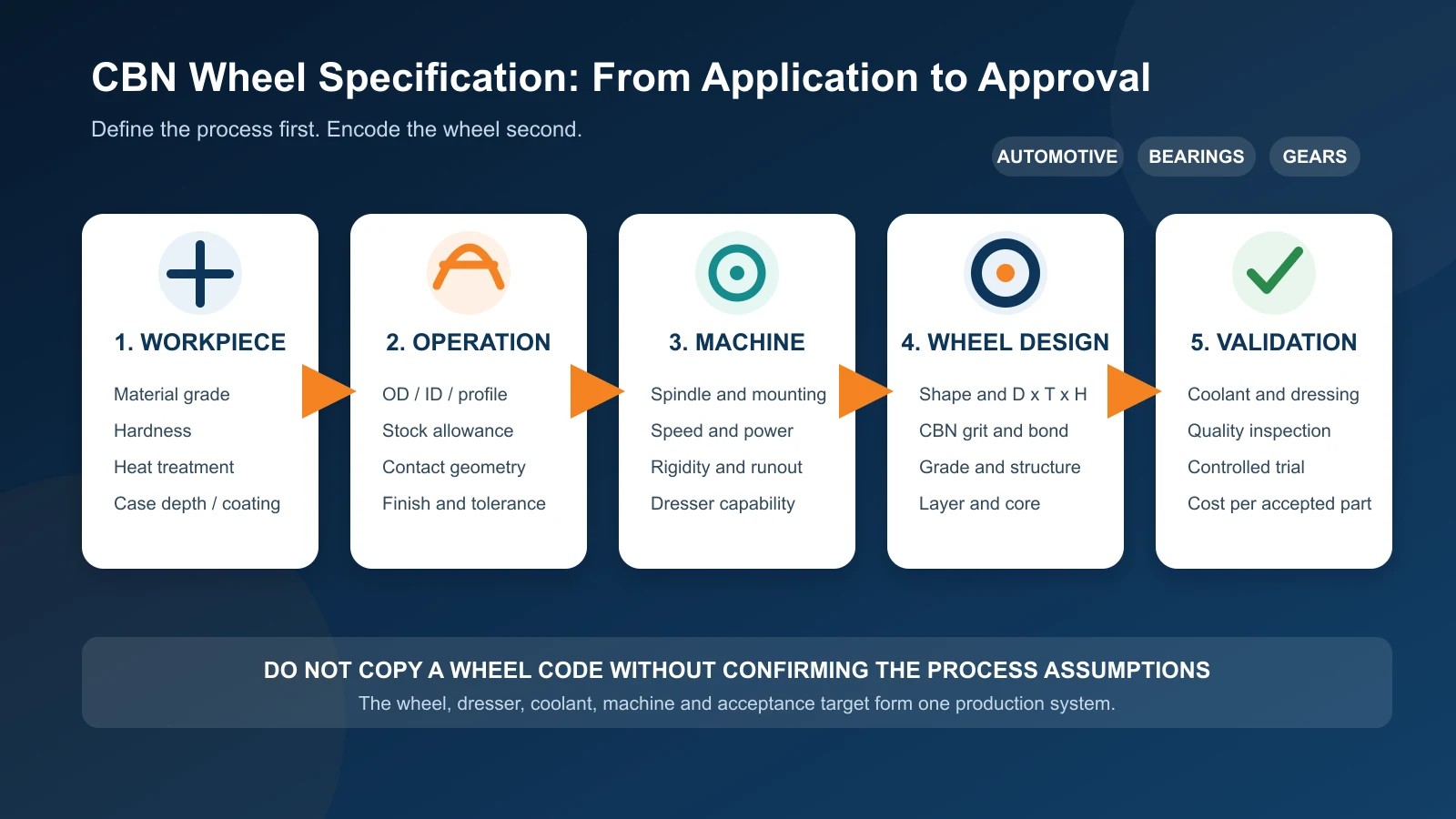
The practical rule is simple: specify the process first and encode the wheel second. Two wheels with the same outside dimensions can behave very differently when their CBN grit, bond, grade, porosity, concentration, abrasive-layer geometry, core and dressing method are different. Conversely, a wheel code that works on one machine should not be copied to another machine without checking speed, stiffness, power, coolant delivery and dresser capability.
This guide is written for production engineers, buyers and sourcing teams working with hardened automotive parts, bearing components and gears. It provides a decision framework for preparing a quote-ready specification without pretending that one universal grit or bond will fit every plant.
Quick Answer: What Must a CBN Grinding Wheel Specification Include?
At minimum, send the following eight data groups:
- Workpiece: exact material grade, heat treatment, hardness and coating or case depth if relevant.
- Operation: external, internal, surface, profile, plunge, traverse, continuous generating or other defined grinding method.
- Wheel geometry: shape, outside diameter, total width, bore or mounting interface, abrasive-layer width/depth and profile drawing.
- Machine: manufacturer, model, spindle power, approved speed range, mounting system, rigidity constraints and available dresser.
- Process: wheel speed or RPM, work speed, feed/infeed, stock allowance, contact width and wet/dry condition.
- Coolant system: fluid type, nozzle arrangement, pressure/flow if known, filtration level and temperature control.
- Quality target: dimensional tolerance, profile accuracy, roundness, surface roughness, burn limit and inspection method.
- Commercial control: trial quantity, annual demand, approved revision, packaging/marking and repeat-order traceability.
If any of those groups is unknown, mark it as unknown rather than guessing. A supplier can recommend a starting wheel only when the missing assumptions are visible.
How to Read the Main Specification Elements
The exact marking system varies by manufacturer, especially for proprietary CBN grain, bond, grade and structure codes. Do not assume that two suppliers use identical internal codes. Instead, compare the engineering meaning of each field. Not every field applies in the same way to vitrified, resin-bond, electroplated and other constructions, so the supplier should identify which elements are fixed, selectable or not applicable.
| Specification element | What it controls | What the buyer should provide or confirm |
|---|---|---|
| Wheel shape and profile | Contact geometry, accessibility and generated part form | Wheel drawing, profile radii/angles, relieved areas and part drawing |
| D × T × H and abrasive layer | Machine fit, usable width, stiffness and available abrasive depth | Outside diameter, total width, bore/interface, abrasive width and depth |
| CBN grit designation | Chip size, cutting action, achievable finish and wear behavior | Stock removal, finish target, edge/profile sensitivity and current grit if known |
| Bond system | Grit retention, dressability, thermal behavior and form holding | Operation, contact area, dressing method, coolant and production volume |
| Grade / bond hardness | How readily worn grain is released and new cutting edges are exposed | Material hardness, power, loading/burn tendency and required form retention |
| Structure / porosity | Chip clearance, coolant access, cutting density and wheel strength | Contact length, removal rate, coolant delivery and loading risk |
| CBN concentration | Amount and distribution of superabrasive in the working layer | Supplier recommendation tied to bond, grit and application; codes are not universal |
| Core and mounting | Wheel mass, stiffness, balance, heat flow and spindle compatibility | Hub material, flange/arbor drawing, bolt pattern, keyway and permissible mass |
| Maximum operating speed | Safety limit and process window | Machine RPM range and required surface speed; never exceed the marked limit |
| Dressing system | Restored geometry and wheel-face condition | Dresser type, roll specification, speed ratio, infeed, traverse and dressing frequency |
FEPA explains that superabrasive grit designations use D for diamond and B for CBN. That prefix identifies the abrasive family, but it does not by itself define the final surface finish or cycle result; the bond, structure, dressing and process conditions still matter. See the FEPA standards overview for the distinction between bonded-abrasive, coated-abrasive and superabrasive grit systems.
Which Bond Fits the Grinding Operation?
Bond selection is one of the most consequential parts of a CBN wheel specification. Screen the main options this way, then confirm the choice against the actual process:
- Vitrified CBN: often evaluated for production OD/ID, bearing components, shafts and dressable gear grinding. Verify machine stiffness, wheel speed, coolant delivery and dresser capability.
- Resin-bond CBN: considered for surface, toolroom and selected finish-grinding duties where relatively free cutting is useful. Verify heat, profile retention, conditioning and production rate.
- Electroplated or single-layer CBN: useful for fixed profiles and localized features. The exposed layer is not handled like a conventional dressable vitrified rim, so form life and replacement or replating strategy matter.
- Metal or hybrid CBN: reserved for application-specific requirements such as strong grit retention or form holding. Confirm dressing, heat generation and supplier evidence for the exact operation.
3M lists cylindrical ID, cylindrical OD and surface grinding among the focused applications for its vitrified CBN technology. That supports vitrified CBN as an important option for precision production, but it does not mean every ID, OD or surface operation should use the same grade, structure or speed. Review the 3M vitrified CBN technology overview for the manufacturer’s application scope.
Automotive Grinding: Specify the Feature, Not Just the Part Name
“Automotive CBN wheel” is too broad for a reliable quotation. A crankshaft journal, crankshaft shoulder, cam lobe, transmission shaft and fuel-injection bore create different contact conditions and quality risks.

- Crankshaft journal or pin: state plunge or traverse, journal width, fillet or shoulder contact, material, hardness, machine power and coolant access. Control burn, chatter, taper and shoulder damage.
- Camshaft lobe: define the lobe profile, base circle, nose contact, profile accuracy, dresser path and compensation. Control profile error, burn, waviness and dress-related variation.
- Transmission or gear-shaft journal: identify peel/Quickpoint, plunge or traverse grinding, interrupted features, roundness and finish. Control chatter, local burn and inconsistent spark-out.
- Fuel-system bore or valve-train feature: provide bore diameter, length-to-diameter ratio, quill stiffness, coolant path and runout target. Control taper, bell-mouth, loading and quill deflection.
For crankshaft grinding, coolant access can become the limiting constraint at shoulders and other partially shielded features. Noritake’s published crankshaft CBN example specifically addresses parts susceptible to grinding burn where coolant exposure is limited. Treat that as evidence that feature geometry and coolant access belong in the specification, not as a universal recommendation to copy the example wheel code. See Noritake’s crankshaft CBN wheel application page.
Automotive RFQ data that prevents rework
Include the part drawing and highlight the exact ground surfaces. State whether the process is new or a replacement for an approved wheel. For a replacement, provide the full current wheel marking, a photo of the wheel label, the last approved drawing revision and measured performance—not only the supplier name.
Record power, cycle time, dress interval, wheel life, burn inspection result, surface roughness and scrap/rework rate under a stable production window. Those values create a baseline for the trial and prevent a new wheel from being judged only by how it feels during the first few parts.
Bearing Grinding: Separate Bore, Raceway, OD and Roller Requirements
Bearing steel alone does not determine the wheel. A CBN grinding wheel for bearing steel still has to match the actual operation: a bearing bore has a small wheel, high speed and quill-stiffness constraint; a raceway adds profile and contact demands; an OD or roller operation uses a different wheel size and contact length.
- Internal bore grinding: define wheel diameter, arbor or quill interface, layer width, speed capability and coolant path. Record bore size, length, roundness, cylindricity, taper and quill runout.
- Raceway or groove grinding: supply the profile drawing, radii or angles, dressing method and form-retention target. Record profile deviation, burn inspection and compensation.
- Ring OD grinding: state wheel width, contact length, stock, workholding and roundness target. Record waviness, surface finish, cycle time and power trend.
- Roller grinding: define part geometry, loading method, contact stability and surface-integrity target. Record size variation, roundness, waviness and accepted parts per dress.
For small-bore work, specify the assembled tool rather than only the abrasive head. Arbor material, connection geometry, overhang, runout and balance can determine whether the theoretical wheel specification is achievable on the machine. Wewin’s vitrified-bond CBN internal grinding wheels with arbor page shows the type of dimensional and interface information needed for an application review.
If the requirement is an internal raceway or groove, also review the vitrified CBN internal and groove grinding wheel configuration. The article and product page should work together: this guide explains how to specify the process; the product page shows the relevant wheel family.
Gear Grinding: Identify the Grinding Method Before Choosing the Wheel
Gear grinding is not one operation. The specification changes between continuous generating grinding, profile grinding, internal gear grinding and grinding of shaft journals or undercuts adjacent to the gear.
- Continuous generating grinding: provide module, pressure angle, helix angle, number of starts, face width and dresser capability. Threaded-wheel geometry, compensation and form accuracy are central.
- Profile grinding: define tooth-space geometry, root or fillet access, contact path and stock distribution. Wheel profile, edge integrity and form retention need tighter control.
- Internal gear grinding: state internal diameter, access or interference, spindle and arbor constraints. Wheel diameter, mounting stiffness and coolant delivery may limit the design.
- Gear-shaft journal or undercut grinding: define the journal or undercut, shoulder access and relation to tooth features. A cylindrical or form wheel may be more suitable than a threaded wheel.
Norton’s technical overview notes that vitrified CBN can be used in both continuous generating and form-grinding contexts, while also emphasizing that CBN dressing requires much smaller compensation than conventional wheels. The important sourcing lesson is not a universal dress amount; it is that the dresser, alignment and compensation strategy must be defined with the wheel. See Norton’s “Why Select Gear Grinding with cBN?”.
When discussing a CBN wheel for gear grinding, send the gear drawing and the intended grinding method. “Gear grinding” without module, tooth form, material, hardness, stock, machine and dresser data is not enough to select a threaded or profile wheel.
How Grit, Grade and Structure Should Be Decided
A finer grit is often associated with a finer achievable finish, while a coarser grit may provide more chip space and stronger individual cutting points. That direction is useful, but it is incomplete. A fine wheel can rub or load if the structure, grade, dressing and feed are wrong; a coarser wheel can still produce an acceptable finish when the process is stable and the dressing condition is controlled.
Use this sequence:
- Define the maximum stock per cycle and the required final roughness/profile.
- Identify the contact length and whether it changes during the cycle.
- Check burn, loading and wheel-wear risks from the current process.
- Confirm the available wheel speed, power, stiffness, coolant and dressing system.
- Ask the supplier to explain the proposed grit, grade and structure as one system.
- Approve the specification only after a controlled trial meets the agreed acceptance criteria.
Do not compare isolated grit numbers across suppliers as if the bond and structure were identical. The same nominal grit can cut differently in different vitrified, resin, plated or hybrid systems.
Convert Wheel Speed to RPM and Check the Machine Limit
If the process target is expressed as peripheral speed, calculate the corresponding spindle speed before approving the wheel:
RPM = (60 × wheel speed in m/s) ÷ (π × wheel diameter in metres)
Example: a 0.350 m wheel at 60 m/s requires approximately 3,274 rpm. This is only a unit conversion, not a recommendation that 60 m/s is correct for the application.
The approved operating point must remain within the wheel manufacturer’s marked maximum speed, the machine spindle range and the guard/mounting limits. OSHA requires checking that machine spindle speed does not exceed the maximum operating speed marked on the wheel; local regulations and the machine/wheel manufacturer’s instructions also apply. See OSHA 1910.215.
How Should Dressing and Coolant Be Specified?
A purchase drawing that omits dressing and coolant conditions is incomplete for many production CBN applications.
For dressing, record:
- dresser type and supplier code;
- roll/disc geometry and usable width;
- dressing speed ratio and rotation direction;
- infeed per pass and total compensation;
- traverse rate or programmed path;
- dressing frequency and trigger;
- post-dress break-in or stabilization procedure.
For coolant, record fluid type, concentration control, nozzle position, pressure/flow if measured, filtration and temperature. A wheel change may fail because the old nozzle misses the new contact zone or because swarf recirculation loads the wheel. Those are system problems, not automatically wheel-quality problems.
For setup and process-control details, use the separate CBN grinding wheel setup guide. Keeping setup in its own article prevents this specification guide from duplicating mounting and troubleshooting instructions.
Use This Quote-Ready CBN Wheel Specification Template
Copy the following table into an RFQ. Attach drawings and photos separately.
| RFQ field | Required information |
|---|---|
| Part and industry | Part name, automotive/bearing/gear use, drawing number and revision |
| Material | Exact grade, hardness range, case depth/coating and heat-treatment condition |
| Grinding operation | OD, ID, surface, plunge, traverse, profile, generating or other defined method |
| Ground feature | Diameter/width/length, interrupted features, fillets, shoulders, grooves or tooth data |
| Stock and cycle | Initial/final stock, number of passes, current cycle time and production volume |
| Quality target | Tolerance, roundness/cylindricity, profile/lead, surface roughness and burn limit |
| Wheel geometry | Shape, D × T × H, abrasive-layer dimensions, profile and mounting drawing |
| Current wheel | Full marking, supplier drawing, photos, dress interval, life and failure mode |
| Machine | Manufacturer/model, spindle interface, power, RPM/speed range and guard limits |
| Dressing | Dresser type/code, parameters, compensation, frequency and available axes |
| Coolant | Type, concentration, nozzle, pressure/flow, filtration and temperature control |
| Trial plan | Trial quantity, baseline data, acceptance limits and authorized process changes |
| Supply control | Annual demand, lot size, marking, certificate/inspection needs and repeat-order revision |
How to Compare Two Supplier Proposals
Do not compare only unit price or an abbreviated wheel code. Ask each supplier to state:
- which application facts the recommendation assumes;
- proposed shape, dimensions and abrasive-layer geometry;
- CBN grit, bond family, grade/structure and concentration terminology;
- core, mounting, balance/runout and maximum operating speed;
- required dressing and coolant conditions;
- expected trial sequence and which variables may be adjusted;
- inspection documents and repeat-order controls;
- what constitutes a specification revision after the trial.
Then compare cost per accepted part, not merely cost per wheel. A simplified starting model is:
Cost per accepted part = (wheel cost + dressing cost + downtime cost + trial/scrap cost) ÷ accepted parts
Add energy, coolant, labor or inspection costs when they materially differ between proposals. The purpose is to compare the full production effect, not to imply that every plant uses the same accounting model.
Use the same baseline, production window and inspection method for every proposal. If the supplier changes both the wheel and several machine parameters, record those changes so the result can be reproduced.
How Should a Production Trial Be Approved?
An approval trial should answer a defined question. Before running the new wheel:
- Record baseline wheel, machine settings, dressing, coolant, cycle and inspection results.
- Define non-negotiable safety and quality limits.
- Agree which process variables may be adjusted and by whom.
- Inspect initial parts and stabilized production separately.
- Track power, burn, roughness, size/profile, dress interval, wheel wear and accepted output.
- Stop the trial if the agreed safety or quality limit is exceeded.
- Freeze the approved wheel drawing, marking and process window with a revision number.
The final purchase description should reference that approved revision. This is especially important for custom wheels, where an incomplete repeat order can create avoidable trial cycles and procurement delays.
Which Specification Mistakes Should Buyers Avoid?
- Sending only D × T × H: dimensions do not define cutting behavior. Send the eight data groups and drawings.
- Copying a competitor’s wheel code: proprietary codes and process assumptions differ. Translate the code into material, bond, grit, structure, geometry and process requirements.
- Asking for “a bearing wheel” or “a gear wheel”: name the bore, raceway, OD, roller, tooth profile, generating method or shaft feature.
- Choosing the finest grit for finish: fine grit cannot correct rubbing, loading or unstable dressing. Balance grit with stock, structure, grade, dressing and feed.
- Ignoring the dresser: a dressable CBN wheel and dresser operate as a system. Include dresser geometry, parameters and compensation.
- Reusing the same RPM after changing diameter: recalculate peripheral speed and check marked and machine limits.
- Approving only by wheel life: track accepted parts, cycle, dressing, quality and total cost.
Wewin Abrasives reviews custom CBN projects from the workpiece, machine, wheel drawing and target result. Start with the CBN grinding wheels category or the vitrified-bond CBN cylindrical grinding wheel page, then send the RFQ data above for technical and commercial review.
Frequently Asked Questions
What is a CBN grinding wheel specification?
It is the controlled definition of the wheel and the process assumptions behind it. It normally includes shape, dimensions, abrasive-layer geometry, CBN grit, bond, grade/structure, concentration terminology, core, mounting, maximum speed and dressing requirements, plus the workpiece, machine, coolant and quality targets used to select them.
Which CBN bond is best for bearing grinding?
There is no universal best bond. Vitrified CBN is frequently evaluated for dressable production ID and OD grinding, but the correct design depends on bore or raceway geometry, material/hardness, wheel size, quill stiffness, coolant, dresser and quality target. Resin, plated or other constructions may fit different bearing operations.
What information is needed to quote a CBN wheel for gear grinding?
Provide the gear drawing, material and hardness, grinding method, module, pressure angle, helix angle, face width, stock, machine, current wheel, dresser, coolant, quality grade/profile targets and production volume. For profile or internal grinding, include access and interference constraints.
Should the supplier choose the grit size?
The buyer should provide stock, finish, geometry and baseline data; the supplier should propose and explain the grit together with the bond, grade, structure and dressing method. The final choice should be validated by a controlled trial.
How should an approved CBN wheel be reordered?
Reference the approved supplier drawing, wheel marking, revision, machine/application and any agreed inspection record. Do not reorder only by diameter and grit. If the workpiece, machine, coolant, dresser or quality target changes, request a specification review.
Use This Final Specification Checklist
Before issuing the purchase order, confirm that the drawing and quotation agree on:
- workpiece grade, hardness and exact ground feature;
- grinding method, stock and quality target;
- wheel shape, dimensions, layer and mounting interface;
- CBN grit, bond and supplier-specific grade/structure/concentration codes;
- core, balance/runout and maximum operating speed;
- dresser, coolant and trial assumptions;
- acceptance criteria, approved revision and repeat-order traceability.
A strong CBN grinding wheel specification does not promise a result from one code alone. It creates a traceable connection between the part, machine, wheel, dressing, coolant and measured production result. That is what makes a trial repeatable—and a repeat order lower risk.
Share this article: