A practical guide to grinding speed and efficiency, covering wheel speed, work speed, stock removal, dressing and coolant control for industrial grinding.
Grinding speed alone does not determine grinding efficiency. A productive process balances wheel speed, work speed, depth of cut, feed, wheel specification, dressing condition and coolant delivery. The objective is not the highest possible RPM; it is the highest stable material-removal rate that still meets requirements for burn, surface finish, dimensional accuracy and wheel life.
This guide explains how to optimize grinding speed and efficiency for conventional, CBN and diamond grinding wheels without relying on unsafe or misleading “faster is always better” rules.
How Grinding Speed and Efficiency Are Measured
For surface grinding, the material-removal rate can be expressed as:
Q = bw × ae × vw
- Q: material-removal rate
- bw: grinding contact width
- ae: effective depth of cut
- vw: workpiece or table speed
The specific material-removal rate per unit width is Q′ = ae × vw. This is why simply increasing grinding wheel speed does not automatically increase output: removal rate is created primarily by engagement and work speed, while wheel speed changes chip thickness, force, heat generation and surface finish. A review of high-productivity precision grinding discusses the same process-limit approach and the relationship between removal rate, specific energy and part quality in more detail: Towards High Productivity in Precision Grinding.
1. Set Grinding Wheel Speed Safely Before Optimizing It
Grinding wheel surface speed is the peripheral speed at which abrasive grains pass the workpiece. It is normally expressed in metres per second (m/s) or surface feet per minute (SFPM).
Use the following conversion when the wheel diameter and target surface speed are known:
RPM = (60,000 × vs) ÷ (π × D)
- vs: wheel surface speed in m/s
- D: wheel diameter in mm
The calculated RPM is only acceptable when it remains within the marked maximum operating speed of the wheel and the rated limits of the spindle, flange, guard and machine. OSHA requires the machine spindle speed to be checked before mounting so that it does not exceed the maximum speed marked on the wheel. See OSHA 29 CFR 1910.215.
| Wheel family | Typical starting envelope | What must be confirmed |
|---|---|---|
| Conventional aluminum oxide or silicon carbide | Often around 20–35 m/s on general-purpose precision grinders | Wheel label, bond, diameter, machine speed range and application |
| Resin-, vitrified- or metal-bond CBN | Can range from conventional speeds to high-speed grinding systems | Bond system, wheel body, balancing, spindle power, coolant and manufacturer rating |
| Diamond grinding wheels | Highly application- and bond-dependent | Workpiece material, bond, wheel construction, coolant and rated maximum speed |
These values are starting envelopes, not universal settings. Some high-speed CBN and diamond systems operate at 60–120 m/s or above, but only when the complete wheel–spindle–guard–coolant system is designed and rated for that speed. Do not transfer a high-speed value from one machine or wheel to another.
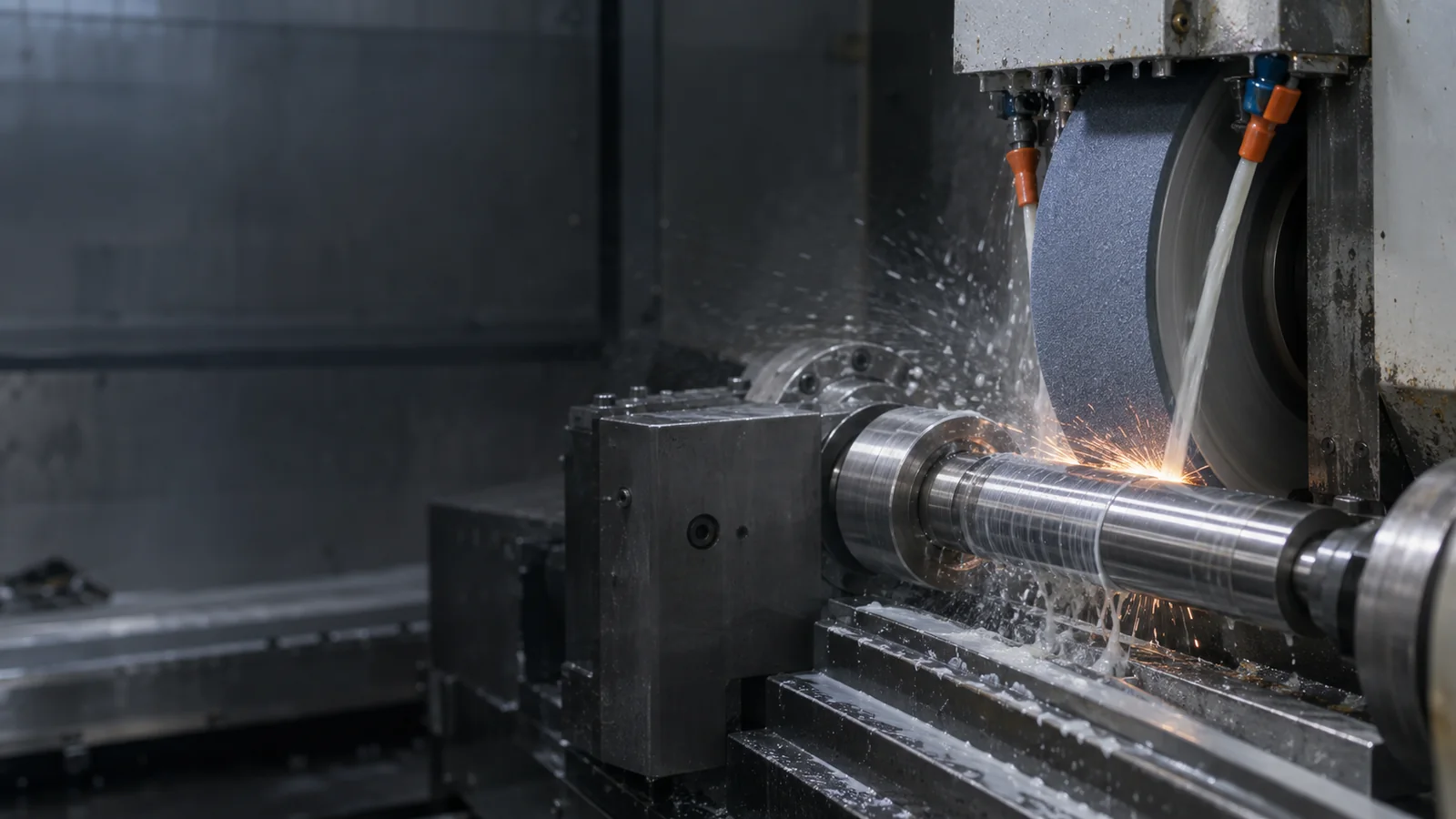
2. Match Wheel Speed, Work Speed and Chip Thickness
Wheel speed and work speed must be evaluated together. Their ratio influences undeformed chip thickness, grinding force, wheel wear and surface texture, but there is no universal “60-to-120 times” rule that works for every surface, cylindrical, internal or centreless grinding process.
As a general process tendency:
- Increasing wheel speed while holding other parameters constant usually reduces chip thickness and can improve finish, but may increase rubbing if the wheel is too closed or dull.
- Increasing work speed or table speed increases material-removal rate and chip thickness, but may also increase force, roughness and power.
- Reducing work speed can improve finish in some operations, yet excessive dwell can increase heat input at the contact zone.
- Changing depth of cut has a direct effect on removal rate, force and thermal load.
Because these effects interact, change one parameter at a time and record spindle power, cycle time, workpiece temperature or burn indication, roughness, size variation and wheel wear. For more detail on wheel, grit, grade and bond selection, see our grinding process and wheel selection guide.
3. Increase Removal Rate Through Depth and Feed—not RPM Alone
The fastest stable process normally comes from coordinated grinding parameter optimization, not maximum wheel speed. Separate rough grinding from finish grinding because the two stages have different priorities.
Rough Grinding Strategy
- Use the highest stable depth of cut and work or table feed that the machine, wheel and fixture can support.
- Choose a sufficiently open wheel structure and grit size to carry chips away without loading.
- Monitor spindle power and vibration instead of judging the cut by sound alone.
- Leave a controlled finishing allowance rather than mixing heavy stock removal with the final surface requirement.
Finish Grinding Strategy
- Reduce depth of cut and stabilize the infeed.
- Use wheel speed and work speed to control chip thickness and surface texture within the rated system limits.
- Keep wheel runout, balance and dressing condition under control.
- Use spark-out only when it measurably improves size or form; unnecessary spark-out adds cycle time without creating output.
The correct roughing and finishing split reduces total cycle time because it avoids the expensive combination of slow stock removal followed by rework.
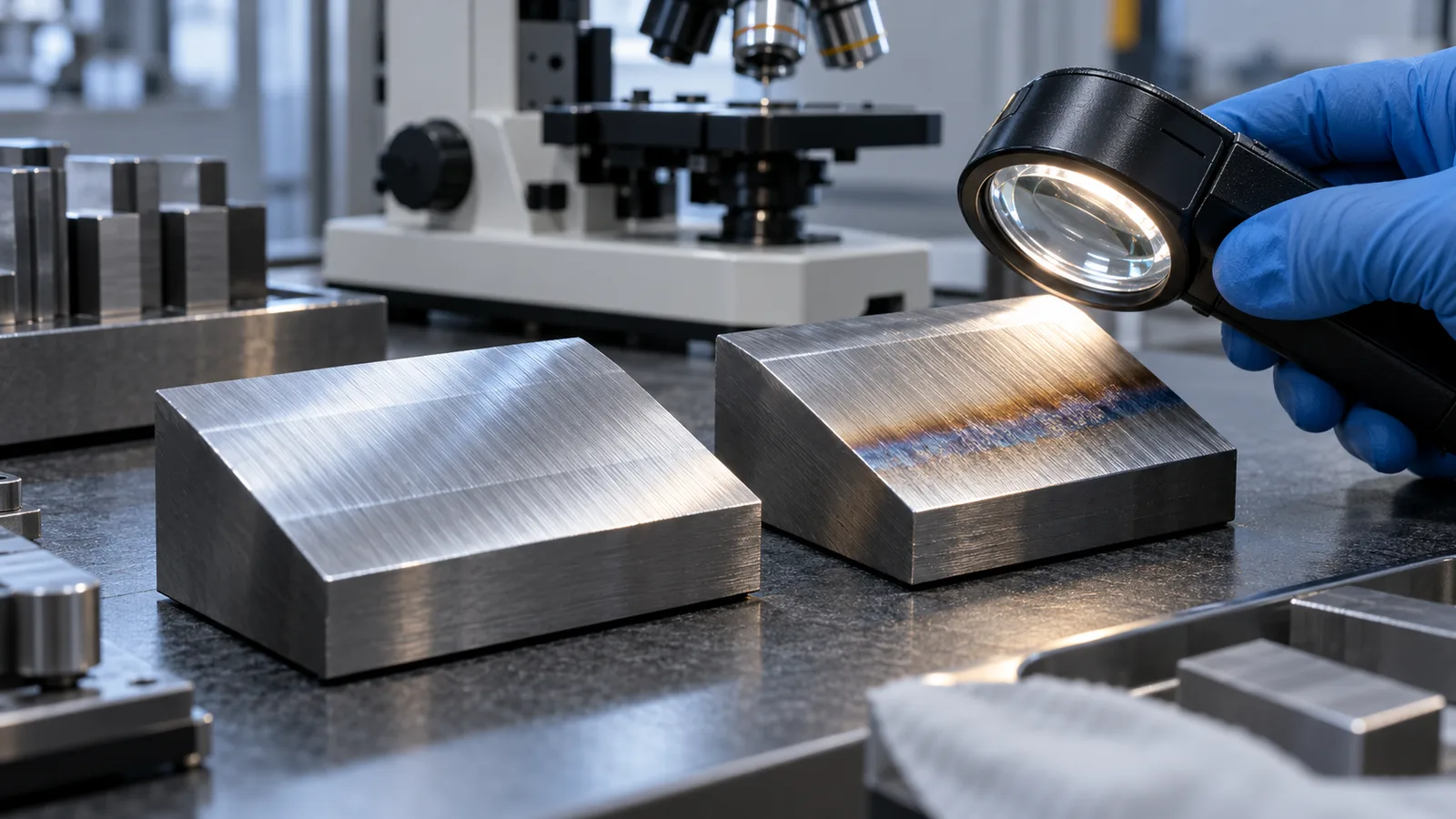
4. Treat Grinding Burn as a System Problem
Grinding burn is not solved by one automatic adjustment. Discoloration, tempering, tensile residual stress and cracking can result from a combination of excessive specific energy, poor coolant delivery, wheel loading, unsuitable wheel specification, excessive infeed, long dwell or unstable dressing.
| Symptom | Likely causes to check | Controlled adjustment |
|---|---|---|
| Burn or temper colour | Loaded wheel, insufficient coolant, excessive infeed, long dwell, unsuitable bond or grade | Restore coolant delivery; dress the wheel; reduce infeed or dwell; test a more free-cutting specification |
| Rough surface | Excessive chip thickness, coarse grit, vibration, poor dressing | Reduce feed or depth; improve dressing; correct balance and runout; verify grit selection |
| Chatter or waviness | Machine or fixture compliance, wheel imbalance, aggressive infeed, poor truing | Check stiffness and mounting; balance and true; reduce infeed; move away from resonant speeds |
| Rapid wheel loading | Wheel too hard or dense, dull abrasive, weak coolant flushing, unsuitable abrasive | Dress more openly; improve flushing; select a softer or more open wheel; verify abrasive/workpiece match |
| High wheel wear | Wheel too soft, excessive chip load, aggressive dressing, vibration | Review grade and bond; reduce chip load; stabilize dressing and machine condition |
A peer-reviewed study of creep-feed grinding fluid effectiveness found that burn limits depend on the complete grinding system—including wheel type, work material, fluid, flow and nozzle application—rather than one universal setting. See Assessment of Grinding Fluid Effectiveness in Continuous-Dress Creep Feed Grinding.
5. Wheel Selection and Dressing Often Matter More Than Speed
A dull, loaded or incorrectly specified wheel converts more input energy into rubbing and heat. Increasing RPM or feed without restoring cutting ability usually makes the problem worse.
- Aluminum oxide: commonly used for carbon steel, alloy steel and general ferrous grinding.
- Silicon carbide: commonly selected for cast iron, non-ferrous metals and selected hard or brittle materials, depending on the bond and operation.
- CBN: suited to hardened ferrous materials such as bearing steel, high-speed steel and many tool steels.
- Diamond: preferred for carbide, ceramics, glass and other hard, brittle non-ferrous materials; it is generally not the first choice for grinding steel because of chemical wear at grinding temperatures.
Coarser grit and a more open structure often help roughing and chip clearance. Finer grit supports finish, but a wheel that is too fine, hard or dense can load and generate heat. Dressing strategy changes the wheel’s cutting topography as much as many machine settings. Review our grinding wheel dressing methods guide before increasing process severity.
6. Coolant Delivery Determines How Far Parameters Can Be Increased
Grinding fluid must reach the contact zone at adequate flow and velocity. A large pump does not guarantee effective cooling if the nozzle misses the wheel–workpiece interface or an air barrier deflects the jet.
- Position the nozzle close to the grinding zone and align the jet with the wheel direction.
- Maintain filtration so chips and loose abrasive do not return to the contact zone.
- Check concentration, temperature and contamination on water-based systems.
- Confirm that guards and enclosures can manage the increased fluid and wheel speed.
- For dry grinding, use more conservative depths and feeds and monitor workpiece temperature closely.
For superabrasive processes, our CBN grinding wheel setup guide covers mounting, RPM calculation, dressing and coolant checks as one system.
7. A Repeatable Method to Improve Grinding Speed and Efficiency
Use a controlled trial rather than random machine adjustments:
- Record the baseline. Note wheel specification, diameter, speed, work speed, infeed, coolant, dressing condition, cycle time, power, roughness and part quality.
- Define the limiting defect. Decide whether the present constraint is burn, roughness, size variation, chatter, wheel wear or cycle time.
- Confirm wheel condition and coolant first. Do not optimize around a loaded wheel or misdirected coolant jet.
- Change one variable. Adjust depth, work speed, traverse, wheel speed or dressing condition separately.
- Measure the result. Compare specific material-removal rate, power, surface finish, size, burn indication and wheel wear.
- Approach the process limit gradually. Stop increasing removal rate when quality, thermal integrity, vibration or wheel-life limits are reached.
- Lock the approved window. Document the acceptable range rather than one fragile “perfect” setting.
This approach improves grinding speed and efficiency through a repeatable process window that operators can control, rather than a one-off setting that only works on one shift.
Frequently Asked Questions
Does higher grinding wheel speed always increase efficiency?
No. Higher wheel speed can reduce chip thickness and improve finish, but it does not directly increase material-removal rate when depth of cut and work speed remain unchanged. If the wheel is dull or loaded, higher speed may increase rubbing and heat.
What should I change first when grinding burn appears?
First check coolant delivery and wheel condition. Then review infeed, dwell, work speed and wheel specification. Increasing work speed can reduce contact time in some operations, but it also raises removal rate and chip load, so it must be tested rather than applied as a universal cure.
How can I increase grinding efficiency without reducing quality?
Increase specific material-removal rate gradually through depth and work speed while monitoring power, temperature, roughness, dimensional accuracy and wheel wear. Keep the wheel sharp, coolant correctly directed and roughing separate from finishing.
What is the best grinding wheel speed for CBN?
There is no universal CBN speed. The correct value depends on bond, wheel body, diameter, work material, machine, coolant and the wheel’s marked speed rating. High-speed CBN grinding requires a wheel and complete machine system designed for that speed.
Should rough grinding and finish grinding use the same parameters?
Usually not. Rough grinding prioritizes stable stock removal and chip clearance. Finish grinding uses lower infeed and controlled chip thickness to protect surface finish, form and dimensional accuracy.
Request a Grinding Process Recommendation
To evaluate a grinding wheel or parameter problem, send us the workpiece material and hardness, grinding method, wheel dimensions, abrasive and bond, current surface speed or RPM, depth of cut, work speed, coolant condition, target roughness and the defect you are seeing.
Wewin Abrasives can help match diamond and CBN grinding wheels, conventional wheels and dressing tools to the required removal rate, finish and process stability.
Share this article: